What I am about to tell you, I do not tell for reasons of asking for sympathy but to share what life in Nepal is at the moment. The behavioral change is most likely not permanent, it takes too much energy in the long term, but it will take a while. I read this article on the Guardian on the mental health disaster that is potentially brewing in Nepal. Having lost their homes, family, income and livelihood, it is no wonder. I will not even try to compare my situation with them. But considering that even those who have suffered little will know what I am about to write about should only show that truly, mental recovery of the quake that shook the earth in April and again in May will take time. For many much, much longer than it will take me.
What has changed then? For instance, I have formed new habits. My habit now is that when I enter a room, I check the walls, the pillars and try to figure out the safest spot in any given space (away from windows, outer walls, heavy objects, next to an interior wall, near a pillar if there is one, preferably under a table etc, door entrances are pretty okay too). I do the same routine outdoors. My eyes keep scanning for open spaces as I walk. Sometimes I will feel a little uneasy when I am on the streets and there does not seem to be a secure place to run into, just in case it does shake again: too many tall buildings, too many trees, too many electric lines. In busses I relax, they're pretty safe places to be in that situation.
Another example: Yesterday I went to my Nepali class, we sit down with my friend Katja and do a little small talk. I sit down and I knock the top of the table, it's sturdy. Katja shares my exact thoughts and voices them out loud: "This is a good table, in case it starts shaking again, we can crawl underneath it since the door is a little bit too far away, we might not make it outside in time and then it is better to stay put." Before the quake, the sturdiness of the table would not have been a topic. Leaving the cafe, we laugh at the fact that we make a mental note to pay a visit to the bathroom because looking for a toilet after a quake is no fun. Better take it on with an empty bladder.
Aside from constant escape routing, other feelings that have emerged. I go to dinner with my friend Sally who has decided to go home earlier than planned. We talk about guilt, about feeling guilty of the fact that we have a place to escape to, have a chance of feeling normal, as soon as (hopefully) our feet touch the Nordic ground. Earthquakes will not be an issue for us, possibly never again. This is not the situation for those who stay behind. This kind of security is a luxury and what a luxury it is!
Guilt comes in other forms as well. I give you an example. People have started to greet me on the streets. I am used to little kids shrieking out Hellooo! when I pass them by, but now it's grown-ups too. A middle aged woman joins here hands in a Namaste when I pass her by in the street and young men shout out hellos and thankyous on the street. Random people come up to you to talk and ask what you are doing in Nepal. I tell my story and at the end of the conversation, they thank you for your kindness and volunteering efforts. I don't feel like I deserve it: I am a mere NGO volunteer, just as shaken as they are, just as paralyzed.
I did have nightmares in the beginning, but they stopped rather fast which is nice. I sleep my nights mostly without waking up, but I am very tired. It is normal, I am told, even if it lasts for more than a month. The constant small tremors serve as a reminder and make moving on somewhat slower.
It is very hard to do anything sensible. I am very happy that when I go back, I only have a couple of days at work and then I leave for holidays. I definitely need that time to settle in. And, I will go see a psychologist, just in case, to make sure that I am on the right track to recovery.
At the office, we "work". After the initial burst of energy, everyone working on adrenalin, I think we are now tired. We are the office, sit at the computer but I doubt we get half of what we'd get done on a normal day. I know I don't for sure. People are falling asleep in front of their laptops. To be fair, no one should expect much at this point. The state of the building adds to the abnormal mood: the cracks in the toilet of the office look pretty scary, they go around the whole room; I am banned from upstairs and my colleague from his room. Most of my colleagues are, if not sleeping outside, then at least removed from their respective homes. Recovery takes time, like it or not.
Many of my migrant friends living in Nepal have left, albeit many of them temporarily. They have gone home to calm the nerves of their families, and to some extent, I guess, recover. In a way, I do want to leave early. I talked with my sister on chat a few days ago and she will drive all the way from Turku to Helsinki to come and pick me up from the airport with my 1,5-year-old nieces (twins) that I miss horribly. The idea of the three of them at the airport waiting to pick me up, seeing my family and friends, and spending time with them does make me want to go pack my bags immediately at times. But I won't do that unless I really do not feel like I can stay. I have five weeks left. I have people I care for here and about whom I would worry about if I left now. I want to see them get back to normal as much as I can before waving goodbye and heading for the airport, not knowing if or when I will return.
I do have another, selfish reason for staying. It will be hard to explain how I feel or felt or will feel to a person who has not gone through the same. How do you explain the feeling of something you take granted, like having a ground that does not betray you under you feet be taken away? How can you explain the intense tiredness that is the result of being on your toes for three weeks? For the time being, my best therapy has been here, taking it through with those who do understand and know what it's like. That we never leave the house with a full bladder, that we appreciate the meaning of sturdy tables in a restaurant, it needs no explanation. We understand spaghetti legs. (A week after the earthquake I just felt that my legs cannot hold me up anymore, I could not stand fo the entire night, we call them spaghetti legs.) We understand the faint nausea that is caused by the constant tremors and aftershocks, now up to 240-ish since the first one shook us on April 25. And we know the feeling of guilt that will come when our flight home takes off. And the guilt of survival, of little suffering. Of feeling absolutely helpless and useless in the relief and reconstruction of this country. And those are the reasons for me still staying here. Despite the fact that I know returning would give a peace of mind to my family and friends.
But little by little we move forward. And loved ones, friends, colleagues, when we do see you back home, please be patient with us. Disaster mode is, I presume, not a switch you can just turn off and on. And while here, understand that my messages to you will be short and I may not answer immediately. It does not mean that your well-wishing is not appreciated, it is just a mixture of being very tired, having too many messages to write and not knowing what to say. But know that I am, by and large, fine. Bit by bit, life will go on and get back to normal. I will make stupid jokes, lose things that shouldn't be lost, forget to call you back and be impossibly late everywhere, all the time. I will, probably, be a little bit of a different person though, it has been a humbling experience. But I think it will be for the better.
Näytetään tekstit, joissa on tunniste English. Näytä kaikki tekstit
Näytetään tekstit, joissa on tunniste English. Näytä kaikki tekstit
tiistai 19. toukokuuta 2015

maanantai 4. toukokuuta 2015
Normipäivä Nepalissa? Kyllä ja ei // Back to normal? Yes and no
(For English, scroll below)
Nepalin maanjäristyksestä on nyt kulunut reilu viikko. Kuolleita on yli 7000, loukkaantuneita 15 000, puolisen miljoonaa kotia tuhoutunut tai asuinkelvottomia tämän hetkisen tietojen mukaan. Vanhaa rakennuskantaa edustavissa kylissä osassa 70-90 % asnnoista on maan tasalla. Kathmandun 2,5 miljoonasta ihmisestä on paennut lehtien mukaan lähes puoli miljoonaa ihmistä. Olen itsekin todistanut ääriään myöten pullistelevien bussien ja rekkojen virtaa pois kaupungista: ihmiset istuvat bussien katoilla ja roikkuvat sen ulkopuolella mistä kiinni saavat. Moni Nepalin upeista ja kulttuurihistoriallisesti tärkeistä rakennuksista on tuhoutunut - Dharaharan torni; Kathmandun, Patanin ja Bhaktapurin Durbar aukiot temppeleineen; buddhalaiset Swyambunathin ja Boudhanathin Stupat sekä Pashupatinatihin ja Changu Narayan hindutemppelialueet. Niiden rammat rungot muistuttavat maanjäristyksen perinnöstä vielä pitkään.
Lienee onni onnettomuudessa, että järistys sattui Nepalin ainoana viikkovapaana, lauantaina. Lauantaisin liikenneruuhkat ovat pienempiä, ihmiset kotonaan. En halua edes ajatella, millaisen tuhon järistys olisi aiheuttanut arkipäivänä, kun tiet ovat pullollaan autoja ja skoottereita, työpaikat ja koulut täynnä ihmisiä. Millaisen pakokauhun järistys olisikaan saanut aikaan, kun ihmiset olisivat yrittäneet päästä kaikki yht'aikaa pakoon kouluista, tehtaista ja työpaikoistaan? Ja lienee myös onnenkantamoinen, että järistys tapahtui keskipäivällä, kun suurin osa maaseudun maanviljelijöistä oli työssään pelloilla avoimen taivaan alla.
Viikossa on saatu paljon aikaan. Aukioita on raivattu, pahiten kärsineitä rakennuksia purettu. Materiaalinen apu on lähtenyt matkaan, vaikkakin hitaammin kuin sen pitäisi. Henkinen toipuminen maanjäristyksestä sen sijaan kestää pitkään, eikä se varmasti ole kaikilla päässyt vielä alkuunkaan. Ei edes täällä Kathmandussa, joka selvisi järistyksestä loppuviimein suhteellisen pienin vaurioin. Vuoristokylissä odotetaan silti edelleen apua saapuvaksi.
 |
| Helping handsin varastolla // Distribution center of Helping Hands |
Jälkijäristyksiä yli pitkälti yli sata - en enää huomaa niistä suurinta osaa. Jokainen ohiajava auto ei enää saa aikaan kauhureaktiota. Isommat jälkijäristykset, lähinnä sekunnin kahden nytkähdyksiä, kyllä nostavat edelleen sydämen kurkkuun. Jälkijäristykset voivat jatkua kuukauden ajan. Tuhon laajuus alkaa olla selvillä, joskin on selvää, että kuolleiden määrä nousee mitä pidemmälle hankalakulkuisiin kyliin päästään. Huolta aiheuttaa myös lähestyvä monsuunikausi. Monsuunikauden sateet tekevät elämän teltoissa hankalaksi, ne nostavat sairastumisriskiä erityisesti lapsilla ja vanhuksilla ja saattavat aiheuttaa maanvyörymiä järistysalueilla. Jo ennen monsuunikautta jälkijäristykset ovat saaneet aikaan vyörymiä kylissä, varmasti osin pääjäristystä seuranneiden sateiden aiheuttamina. Monsuunikauden vuoksi on äärimmäisen tärkeää, että jälkihoito saadaan hyvään vauhtiin ennen kuin sateet alkavat kesäkuun alussa.
Suomen suurlähetystö Kathmandussa järjesti perjantaina saunaillan Kathmandussa oleville suomalaisille, siitä äärettömän suuri kiitos. Eräs lähetetyn henkilökunnan tytär oli leiponut juustosarvia ja tehnyt lohitäytteisiä väinämöisen nappeja. Usean päivän likojen valuttaminen pesutilan viemäriin, iholla lempeästi polttava saunan lämpö, hento palavan puun tuoksu ilmassa, kuin olisin ollut jossain muualla. Puhe sorisi lähetystön pihalla, jossa vain kirkkaan keltaiset teltat muistuttivat maanjäristyksesestä: "Missä olit kun järisi?", "Miltä sinusta tuntui?", "Ovatko kaikki läheisesti kunnossa?", "Miltä asunnossasi näyttää, voitteko mennä kotiin?". Tilanteen purku omalla äidinkielellä on tärkeää. Siksi kai bloggaankin.
Kaiken tämän keskellä olen vihdoin käsittelemässä viime viikkoa, joskaan en kovin tietoisesti. Olen hirvittävän väsynyt, enkä saa oikein mitään aikaiseksi. Tänään nukuin kolmen tunnin päiväunet. Kaikki kestää kaksi kertaa pidempään kuin normaalisti. Jos minulla ei ole tekemistä, hermostun ja tulen levottomaksi. Riittämättömyyden tunne on valtava. Näen väkivaltaisia unia. En maanjäristyksestä, mutta uneni ovat täynnä kuolemaa. Se lienee normaalia ja kertoo myös siitä, että kroppani ja pääni on vihdoin tajunnut, ettemme ole enää hengenvaarassa ja se voi alkaa käsitellä tapahtunutta. Käyttäytymistäni normaaliksi en voi kutsua, en esimerkiksi halua viettää yhtään enempää aikaa yksin kuin on pakko. Ihmiselle, joka nauttii viikonlopuista, jolloin ei tarvitse puhua kenellekään tai nähdä yhtään ketään, jolle istuminen kahvilassa kirjaan uppoutuneena on luksusta, on tilapäinen läheisriippuvuus outo tila.
Eilen kävin ensimmäisen kerran nepalin tunnilla. Opettajamme, neljän- ja viidenkymmenen välillä oleva nepalinainen Deepa, on edelleen selvästi maanjäristystilassa. Hän sekoilee, lähettää useita viestejä, siirtää nepalituntia kolme kertaa. Mutta hänellekin on tärkeää päästä normaalirytmiin, luulen. Sitä se on meillekin. Tilanteen poikkeuksellisuudesta muistuttaa vain se, että emme ole vakiopaikassamme Cafe Somassa vaan muualla. Toivon Soman avaavan ovensa pian, sillä haluan nähdä paikan omistajan, aina hymyilevän pyöreäkasvoisen nepalimiehen, joka vaihtaa kanssamme aina muutaman sanan nepaliksi ja yritämme vastata hänelle ontuvalla nepalinkielellä.
Tunnin jälkeen menemme Katjan kanssa Vienna Bakery kahvilaan Jhamsikelissa. Juon americanon ja syön tonnikalavoileivän. Ne maistuvat taivaalliselle. Samalla tunnen hirvittävää syyllisyyttä siitä, että minun elämäni voi palata enemmän tai vähemmän raiteilleen, kun maa on täynnä niitä, joiden elämältä on lähtenyt pohja. Toisaalta tiedän myös, ettei se, että istuisin kotona riisiä syöden paranna kenenkään tilannetta: se ei tuo yhtään menehtynyttä takaisin, eikä jälleenrakenna ainuttakaan kotia.
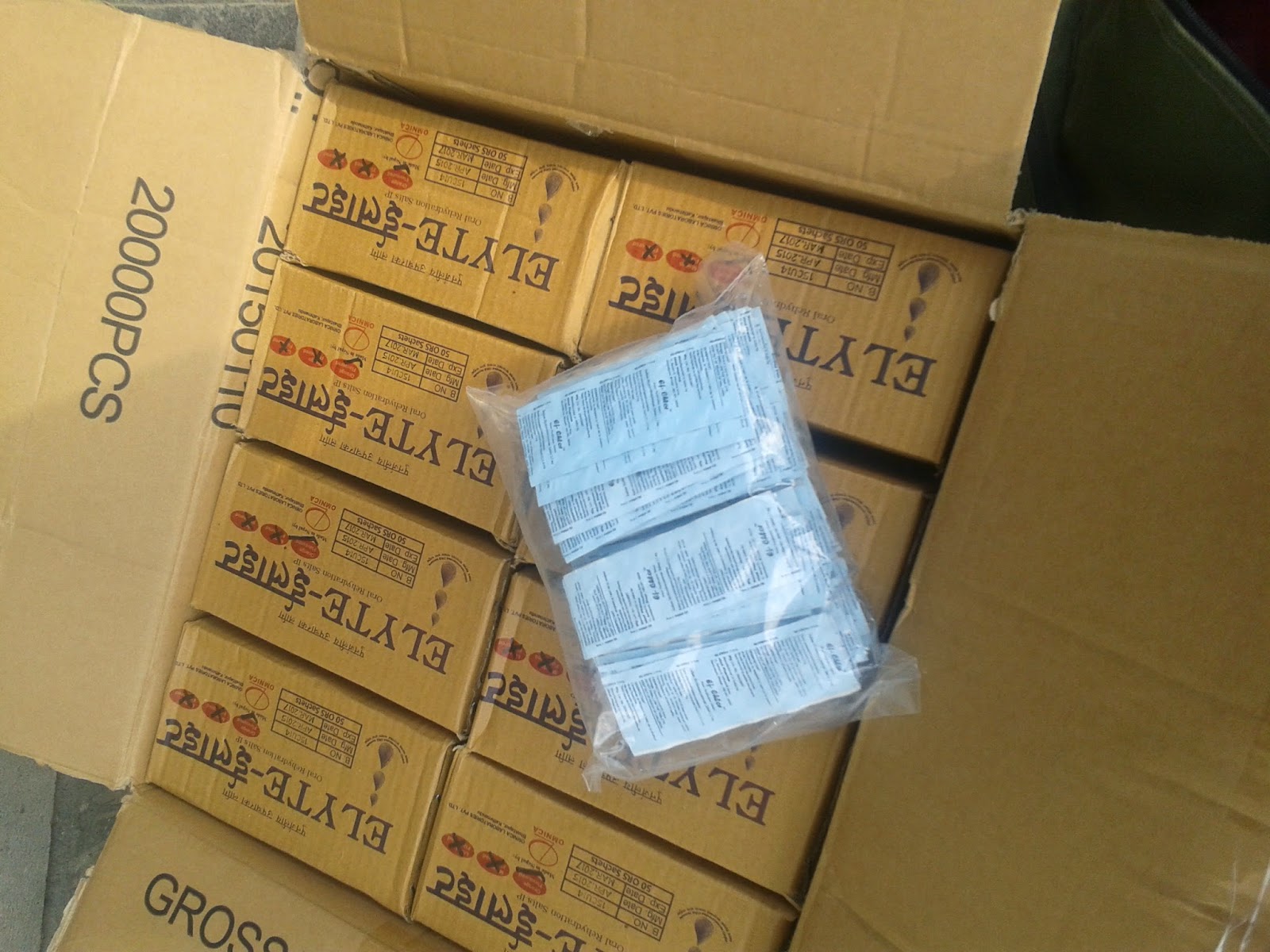 |
| Rehydraatioliuos ja vedenpuhdistustableteille on kysyntää. // Oral rehydration salts and water purification tablets are in high demand |
Teen minkä voin: lahjoitan toimistoni keräykseen, kierrän apteekkeja ja ostan vedenpuhdistustabletteja, rehydraatioliuoksia, särkylääkkeitä ja saippuaa. Vien työkaverilleni kaksi isoa kassillista ruokaa ja hengityssuojaimia jaettavaksi järistyksessä pahoin kärsineessä Khokanan kylässä. Jaan kokemuksiani ja tietoa sosiaalisessa mediassa: ehkä sillä on merkitystä jollekulle. Ehkä se kannustaa jotakuta lahjoittamaan. Kun käytän kahviloiden palveluita, tuon elannon jollekulle. Turismi työllistää nepalissa monta ihmistä. Nähtäväksi jää, miten järistykset vaikuttavat turistivirtoihin. Ainakin nyt se tarkoittaa sitä, että monelta loppuvat työt määrittelemättömäksi ajaksi.
Tuntuu kummalliselle, ettei Nepal ole enää ykkösuutisaihe vaikka tiedän, että niin media toimii. Ilokseni huomaan kuinka paljon ihmiset ovat valmiita tekemään toisella puolella maapalloa sijaitsevan lähimmäisen puolesta - erinäiset keräykset saavat tipan linssiin. Nepalit ja täällä asuvat maahanmuuttajat, matkailijatkin tekevät kellon ympäri töitä auttaakseen niitä, jotka eivät voi auttaa itseään. He lahjoittavat aikaa, rahaa ja tarvikkeita, toimivat kuskeina, purkavat sortuneita rakennuksia paljain käsin.
Ja vaikka elämä on normalisoitumassa, liikenne ruuhkautumassa ja pikkukaupat auki kuten ennenkin, on selvää, että viime viikon pelko on edelleen läsnä. Huhut leviävät villinä. Kuulemme säännöllisin väliajoin, että seuraavan kahden tunnin aikana on odotettavissa valtava, yli 9 Richterin järistys. Ihmiselle, joka pelkää henkensä edestä, on turha vakuutella, ettei kukaan pysty ennustamaan järistyksiä etukäteen vaan että kyseessä ovat ihmiset, jotka haluavat hyötyä tilanteesta, haluavat saada ihmiset jättämään kotinsa, jotta he voivat varastaa, kaiken mikä irti lähtee. Näitäkin ihmisiä on, valitetavasti.
En ole nähnyt edelleenkään valtionhallinnon edustajia. Tilanne on sama muuaallakin. Tai no, eilen yksi poliisiauto ajoi ohi. Neljä päivää sitten takapihallasijaitsevann Community Earthquake Learning Centerin (CELC) työntekijät kiersivät lähialueen taloja. Kolme päivää järistyksen jälkeen. Näen CELCin ikkunastani. Vaikka tämän alueen tilanne on hyvä, on viranomaisten näkyvyydellä valtava merkitys ihmisten henkiselle hyvinvoinnille. Että joku välittää.
Pyrin seuraamaan mediaa ja sen raportointia maanjäristyksestä. Suuri osa uutisista saa minut raivon valtaan. Hallituksen kriisiviestintä on ala-arvoista. Ensimmäinen virallinen osaanotto tilanteesta tuli neljä päivää järistyksen jälkeen kun pääministeri Koirala kommentoi tilannetta medialle. Neljä päivää! Katastrofitilanteessa sympatian osoittaminen tuntuu pieneltä, mutta symbolisesti sillä on valtava merkitys. Tiedonkulku ontuu. Hallitus haluaa epätoivoisesti johtaa katastrofikoordinointia, vaikka sillä ei ole siihen valmiuksia. Se ohjaa kaikkien 25.4. jälkeen avattujen katastrofiapua keräävien tilien tulot omaan Prime Minister Disaster Relief Fundiin. Perustelut toimelle tulevat vasta kaksi päivää päätöksen jälkeen: hallitus haluaa ehkäistä korruptiota ja tilanteesta hyötyä hakevien huijarien toimintaa. Se on ihan validi peruste, joskin Nepalin hallituksen omakaan korruptiohistoria ei herätä luottamusta. (Jos pohditte lahjoittamista, suosittelen isoja (kansainvälisiä) järjestöjä, ne joutuvat raportoimaan käyttämänsä varat tarkasti.) Vasta kolme päivää sitten Nepal päätti, ettei peri tullimaksuja ja arvonlisäveroa (yhteensä 48%) maahan saapuvista teltoista ja pressuista. YK katsoo, että tämä ei ole vielä riittävä toimenpide, kriisiaikana ei tule noudattaa normaaleja tullikäytäntöjä. Hallituksen yhden oven politiikka on viivästänyt avun perille vientiä.
Vaikka tiedän, että kriisitilanteessa toimitaan välillä hölmösti ja vaikka tiedän, että olen maassa, jonka infrastruktuuri ja valtionhallinto ei ole verrattavissa läntiseen pallonpuoliskon vastaaviin, ja jossa asiat hoidetaan jos kulttuurisistakin syistä toisella tavalla, tuntuu siltä, että olen repimässä hiuksia päästäni vähintään kerran päivässä.
Huomenna otan uuden askeleen kohtmaanjäristyksenen jälkeistä normaalia: sain tänään tekstiviestin, että huomenna alkavat työt. Se tuntuu oudolta, mutta työkavereideni näkemistä odotan innolla. Tänään lienee syytä siis ryhtyä pyykinpesuun, jotta pääsee puhtaissa vaatteissa töihin. Kyllä tämä tästä.
***
It has now been a week after the 7,9 Richer quake that shook Nepal. The death toll has climbed up to more than 7000, there are almost 15 000 injured and almost 150 000 homes have collapsed completely and another 150 000 have been partially damaged. The figures are sure the rise as only now the more remote villages have been reached. The dooms dayers are raising their head, blaming the quake on the corrupt politicians or scantily clad tourists. In some villages 70-90 % of houses have been destroyed. Almost half a million people have fled Kathmandu. I myself have witnessed the busses and trucks filled to extreme, carrying away people sitting on top of the busses or hanging on to whatever they can hold on to on the outside. Many of the spectacular and historically important buildings have been demolished or suffered notable damages: the Dharahara Tower, the Durbar Squares of Kathmandu, Patan and Bhaktapur, the buddhist Swayambunath and Boudhanath Stupas, and the Hindu temple areas of Pahupatinath and Changu Narayan. Their sad skeletons will remind the people of the horrors of the quake for a significant time to come.
It is sheer luck that the quake took place on the only day off of the week, Saturday. On Saturday the infamous traffic jams of Kathmandu are a mild version of those during the week. I dare not think the scale of the destruction had the quake occurred on any other day of the week when the streets swarm with people, cars and motorcycles. What kind of panic would the quake caused had the people been forced to flee buildings like workplaces, factories and schools? It is fairly certain that the occurrence at noon saved the lives of many farmers out on their fields at noon, above them only sky.
In a week, a lot has been achieved. Squares have been cleared and badly damaged buildings have been taken down. Material relief has been dispatched, although much slower than it should have. Psychological recovery will take longer than the material but neither will be fast. Many have not yet started psychological recovery as they are still fighting for their life, trying to build their life from scratch. In remote villages, aid is still elusive.
Afterquake count was more than hundred a while ago already. I do not notice most of them anymore. Not every car that drives by causes a panic reaction anymore. Bigger after quakes, jolts lasting a second or two, still bring my heart up to my throat. The after quakes may continue for a month after the main quake. That is a long time to be on your toes. The extent of the damage is beginning to be mapped although the death count will most likely rise as the more remote villages are reached. Adding to the worries and troubles is the monsoon season which brings continuous rains to Nepal in a month or so. The rainy season will make living in tents even more uncomfortable, the increase the risk of disease and compromise hygiene and may cause landslides. Even before the start of the monsoon season, rain has caused landslides in the villages. the monsoon season makes it even more crucial that the relief and reconstruction are well on their way before the rain starts.
The Finnish Embassy in Kathmandu organized a sauna night for the Finnish staying in Kathmandu just three days ago - I cannot tell you how much that was appreciated. The daughter of one of the diplomatic staff had made cheese croissants and other snacks. Dirt gathered over several days, the warmth of the sauna on your skin, the deep cleansing effect of it, the faint smell of burning wood - if I closed my eyes and ignored the bright yellow tents on the grounds of the embassy, I could have been somewhere else entirely. And going over the events of the past few days in your own language is therapy at its best: where were you when it happened, how is your house, are all your friends and family unharmed?
Amidst all of this I am trying to recover, albeit not consciously. For the past two days, I have been tired, very tired. Lethargic. Everything takes a lot of time. It is to be expected I guess, as I have been running on adrenalin up until now. The body needs to start recovering. I have nightmares, not of the earthquake, but the dreams are violent, they are of death. I think it's my brain organizing things and dealing with whatever fears I am not able to handle consciously yet. I feel unaccomplished and useless. I do not want to spend more time alone than I have to which is not normal behavior for me. I love my "me-time" - I can very well spend a weekend just hanging out by myself, not talking to anybody. It is strange to be so dependent on the company of others.
I have been trying to do my best to contribute to the relief efforts, but it feels like I am doing nothing. I have been donating food, oral rehydration salts, face masks, and water purification tablets. I am on social media, partly in hopes of making sure that at least my network will not forget in the coming weeks. Nepal will need help, lots of it, in the upcoming weeks. The monsoon season is just around the corner and with that, come fears of diseases such as cholera and typhoid. I am trying to get back to the normal rhythm: my office is closed and will be for some time suppose, since most of my colleagues of the small 9 person office live in Khokana, one of the areas that have had a lot of damage. I know psychologically I need to try and settle into the normal rhythm. At the same time, I feel incredibly guilty: why am I having a cup of coffee or going to my Nepali class when people are suffering. And yet I know that staying at home feeling horrible will do nothing to help the situation. Survivor's guilt is a very real concept still.
I had my first Nepali class two days ago. Our teacher, Deepa, a woman in here forties or fifties is still in earthquake more. She calls me a few times, cancels and reschedules out class and sends messages to wrong numbers. But I guess getting back to normal is her recovery. It is mine too. The only thing that reminds us of the exceptional circumstances is a new coffee shop. Out regular spot, Cafe Soma is still closed. I sincerely hope that Soma opens soon, I want to see the staff of the cafe, the always jolly owner with his round face smiling and trying to chat us up in Nepali to which we answer in very sorry mix of Nepali and English.
 |
| Kämppikseni avustushommissa // My room mates going off to aid distribution |
After the Nepali class, Katja and I go to Vienna Bakery Cafe in Jhamsikel. I have an americano and eat a tuna sandwich. They taste like little pieces of heaven. At the same time, I feel the guilt at the bottom of my stomach. My life is slowly coming around to its normal state, but the country is full of people who have lost everything. At the same time I know that me sitting at home will not bring back any lost loved one, it will not transform a broken home back to its original state. I do what I can: I donate foods, clothes, water purification tablets, oral rehydration salts, medicines, and soap. I take a big bag of food and face masks to my colleague who will distribute them in Khokana that has suffered a otl in the earthquake. I share my experiences in the (social) media: maybe it will make a difference. Maybe it will encourage someone to donate.
There are thousands of regular Nepali working with relief efforts, working 24/7 to help their country men and women. Many foreigners are staying back in the country, doing what they can to help: we donate hygienic products, food, whatever we can get out hands on. Other's organize collections, have given their vehicles to be used for delivering relief supplies. It is strange that the quake is no longer the news number one in international magazines even though I know that is how the media works. I have been humbled and wiping tears of happiness from my eyes reading about the contributions of both the locals and the international community.
The life in Kathmandu seems to be getting back on track. Many shops are already open, there was even a bit of traffic in the streets of Patan today. But people are jumpy. Rumors spread like wildfire and it is very hard to reason with people who fear for their life. For the past two days there have been rumors of an enormous earthquake hitting Nepal. And even though you try to convince people that no one can predict when or if the next quake will shake the Nepali grounds, that it is just scaremongering, the fear and superstition takes over.
I have not seen a single government official in my area. Neither have others. Or well, yesterday I saw a police car parked outside. Four days ago officials from the Community Earthquake Learning Center (CELC) staff went around the neighborhood. The center is located just 50 meters from my friends house where I'd stayed during the earthquake and its aftermath. One may claim that since the area has not suffered that much, the officials should be elsewhere. But the visibility of government officials has a huge effect when it comes to mental wellbeing and recovery. That someone cares about us.
 |
| Helping Hands kansalaisliike paketoimassa avustuspaketteja // Helping Hands citizen initiative gathering relief materials to be sent out |
I try to read the newspapers to keep up with what is going on. Most of the news infuriate me. Nepali government directing earthquake relief funds to the Prime Minister's relief fund and absolutely failing to distribute them (like people feared they would). Nepali government is in shambles. If there is something to be said, at least the communications from the government has been an utter disaster. People are angry. I am angry beyond words, even though my world, for the most part, remains intact. My friends and colleagues are fine, my home unscathed, I have food, water and emotional support of my friends. It took four days for Prime Minister Koirala to offer his condolences to the people of Nepal. Four days! Offering condolences may seem trivial, but it has a great effect on the morale of the people. Communications have been scarce. The government is desperate to take charge of the rescue and relief operations, but it does not have the capacity to do so. The government has decided to direct all relief funds of recently opened earthquake relief accounts to its own Prime Ministers Disaster Relief Fund. The justifications come only two days after the decision: the government wants to prevent corruption and increase the transparency of the used funds. which is a fair justification however the government's track record is far from being clear and Nepal is one of the most corrupt countries in the world: Transparency International ranks it at 126 globally. (If you are considering donating, big international organizations are your best bet right now: they need to be accountable for the money received). Just three days ago, the government decided that it will not collect customs or VAT (totaling 48 %) on tents and tarpaulins that have been pouring into the country. The United Nations says this is not enough, the normal customs regulations should not stand in a time of crisis. The one door policy of the government has slowed down rescue and relief efforts.
Even though I know that crisis situation mean sometimes stupid mistakes, unwise decisions and even though I do realize that the infrastructure and the governance of this country cannot be compared to the rich west, and I am aware that different where cultural practises come to play, I am pulling the hair out of my head at least once a day. The Nepali people, the people with the biggest hearts I have ever come across, deserve better.
Tomorrow I will take another step on my personal road to recovery: I received a text message from my boss today that said work starts tomorrow. It feels strange, but I am very happy to see my colleagues. Today's chore shall then be laundry, just to have clean clothes for tomorrow. We take baby steps, baby steps one day after another to get back on track.
sunnuntai 19. huhtikuuta 2015
Kulttuurishokki ja koti-ikävä – jokaisen maahanmuuttajan repussa // Culture shock and feeling homesick - the burdens of immigrants
Melko varmasti jokainen, joka on joskus asunut ulkomailla, tietää mitä tarkoitetaan kulttuurishokilla. Kulttuurishokki hiipii pikkuhiljaa. Se on tunne siitä, että muut toimivat ja käyttäytyvät väärin. Pienet asiat saavat ärsyyntymään, välillä suhteettomasti. Vaikkapa se, että Nepalissa kaikki tapahtuu hitaasti, jos ollenkaan. En käsitä, mikä kastijärjestelmän purkamisessa on hankalaa, miksi naimisiin mennessään nainen muuttuu kotitalouskoneeksi tai miten yhden perustuslain sorvaamisessa voi mennä 10 vuotta. Kielteistä vastausta ei anneta, ei edes tilanteessa, jossa kysyt tietä, eikä kysyttävä tiedä missä kohde on. Hän vastaa silti täydellä varmuudella: ”200 metriä tuonne, sisko!”. Ja seuraava vastaantulija ohjaa täysin vastakkaiseen suuntaan. Pyhän vihani saavat taksikuskit, sillä näyttäydyn heille kävelevänä lompakkona, jolta on hyvä huijata kolminkertainen taksa.
Yhtenä iltansa tappelen jälleen taksin hinnasta. Olimme sopineet lähtiessä hinnaksi 300 rupiaa, mutta taksikuski ei aio antaa 500 rupian setelistäni takaisin. Normaalitilanteessa istuisin taksissa, kunnes vaihtoraha on kädessäni — ei tämä ensimmäinen kerta ole. Tuona päivänä kattila vain kiehuu yli. Kerään tavarani ja huudan kuskille: ”Vihaan Nepalia, painu &#%&%#, veli” ja lyön mielenosoituksellisesti oven kiinni niin lujaa kun voin kyynelten kirveltäessä alas poskia. En jaksa edes hävetä, vaikka tiedän olevani maassa, jossa pahaa mieltä ei näytetä, ei näin. Onneksi kulttuurishokki on luonteeltaan aaltoilevaa, se ei ole pysyvä tila.
Illalla höpöttelen hotellihuoneessani Mayan (nimi muutettu) kanssa, jonka olen tavannut vain muutama tunti aiemmin, ja hän kertoo kuin ohimennen elämänhistoriansa minulle. Hän kertoo, kuinka hankalia avioliitot eri kastin edustajien välillä ovat, millaista on olla eronnut nainen Nepalissa, ja kuinka ex-miehen rakastajattaresta ja väkivaltaisuudesta huolimatta hän on se, joka kantaa epäonnistujan ja eronneen stigmaa, joka voi myös olla esteenä avioliitolle tulevaisuudessa.
Maya vaatii saada tietää, miksi näytän alakuloiselle. Sanon, että minulla on hieman koti-ikävä. Hän kaappaa minut halaukseen sanoen: ”Sinun pitää olla rohkea kun olet yksin kaukana kotoa, mutta minä olen sinulle perhe täällä, kaikki on hyvin.” Mietin itsekseni: niin nepalilaista, kolmessa tunnissa me olemme sydänystäviä.
Ja sillä hetkellä tiedän, että vaikka odotan kotiinpaluuta nähden unia mansikoista ja herneistä, tiedän myös, että kesäkuussa kuljen Kathmandun lentokentän turvatarkastuksen läpi silmät siinä samassa sumussa kuin tänne lähtiessänikin.
Teksti on muokattu versio 12.4.2015 Salon Seudun Sanomissa julkaistusta kolumnista
Everyone who's lived abroad I most likely very familiar with the term culture shock. It develops slowly and manifests itself in a feeling that the others are acting and behaving in a way that is not rational. Small things will become big things, and sometimes your reactions are completely out of proportion. The things that bug me here are for instance that everything happens in its own time, if at all. I cannot understand why the caste system, illegal for decades, is still in place and upheld; or why women become more or less domestic workers when they marry; or how it can be possible that the damn constitution is still not in place, after almost 10 years. A negative answer will not be given even in the most bizarre situations. Like when you are looking for a specific place and ask a local for directions. They will answer with absolute certainty: 200 meters that way, sister!" even if they have absolutely no idea where the place is. And the next person will guide you in the complete opposite direction. Taxi drivers are my pet-peeve and the object of my holy wrath. For a great majority of them I am the equivalent of that talking and walking fat wallet that justifies ripping me off my charging a fee three-times the actual one.
One night I am fighting over the price of the taxi again. We had negotiated the price to be 300 rupees, which is still extra but bearable, but when I give the driver a 500 rupee note, he refuses to give me change for sorry excuses. In a normal situation I would sit in the taxi until he hands me the change - this is not the first time. But that day, it is all just too much. I gather my bags and yell at the driver: "I hate Nepal, you can go #€&(%/ off, brother!" and slam the door as hard as I can as the tears of anger run down my face. I do not feel even shame even as I know that in this country, you do not act this way, I am too angry and too frustrated with the situation that keeps on repeating over and over again. Fortunately, a culture shock waxes and wanes, it is not a state of permanence.
Homesickness is another thing you just have to learn to live with. It's Easter. I am sitting in the evening program of a training we've organized for head teachers and contact teachers. I've just finished a Skype call to Salo, where my parents live. Behind the pixelated screen I've seen my parents, my grandma and my sister with her family - only my brother is missing. My 18-month-old nieces run around in excitement, kiss the tablet and shriek joyously a word that I interpret must be "Pauliina". We manage to talk only for 10 minutes because the internet connection at the hotel is bad and it keeps cutting me off- 10 minutes is not nearly enough time. I know that my family has just had a big festive lunch that has been prepared with love and I am not there. I close my laptop reluctantly and join the others in the hall. The room is full of happy people from the training but at that point, I would love to be anywhere but there.
But just as I am up to my ears with Nepal, music that sounds out-of-tune squealing, bad coffee and rules of behavior that I fail to understand or follow, the district education office representative and a group of head teachers take over the dance floor. Middle-aged men shake their hips like Bollywood movie stars, clap their hands, each one singing in their own key, hug one another and laugh from the bottom of their stomach, fuelled up by a glass or two of Coca Cola. Each take turns at the mic, they sing, dance, tell stories or jokes. My bad mood melts away and even the homesickness seems to sink to a tolerable level.
At night, Maya (name changed to protect identity), that I have met only a few hours ago, tells me her life story in passing. She shares how difficult inter-caste marriages still can be in Nepal, what it is like to be a divorced woman in Nepal, and how, depite the fact that her husband beat her and had lovers, she is the one bearing the stigma of a failure and the divorcee that may even prevent her from ever marrying again. She tells me that I look a little down and insists to know why. I tell her that I am feeling a bit homesick. She stands up and envelops me in a big hug and tells me: "You must be brave when you are so far away from home, but do not worry, I will be your family here." I think to myself: this is such a Nepali way of being. Three hours in and I have made a wonderful friend in a random person I just happened to meet.
Yhtenä iltansa tappelen jälleen taksin hinnasta. Olimme sopineet lähtiessä hinnaksi 300 rupiaa, mutta taksikuski ei aio antaa 500 rupian setelistäni takaisin. Normaalitilanteessa istuisin taksissa, kunnes vaihtoraha on kädessäni — ei tämä ensimmäinen kerta ole. Tuona päivänä kattila vain kiehuu yli. Kerään tavarani ja huudan kuskille: ”Vihaan Nepalia, painu &#%&%#, veli” ja lyön mielenosoituksellisesti oven kiinni niin lujaa kun voin kyynelten kirveltäessä alas poskia. En jaksa edes hävetä, vaikka tiedän olevani maassa, jossa pahaa mieltä ei näytetä, ei näin. Onneksi kulttuurishokki on luonteeltaan aaltoilevaa, se ei ole pysyvä tila.
Koti-ikävä on toinen asia, jonka kanssa on vain opittava elämään.
On pääsiäinen. Istun rehtoreille ja opettajille järjestämämme koulutuksen illanvietossa. Olen juuri päättänyt Skype-puhelun Saloon. Ruudun takana olivat vanhempani, siskoni perheineen ja mamma, vain veljeni puuttuu joukosta. Puolitoistavuotiaat siskontytöt suukottivat ruutua ja kiljuivat riemuissaan sanaa, jonka tulkitsin tarkoittavan Pauliinaa. Ehdimme jutella kymmenisen minuuttia, sillä netti pätkii — aivan liian lyhyesti. Suljen koneen vastahakoisesti ja palaan muiden joukkoon. Tila on täynnä hyvätuulisia seminaarilaisia, mutta sillä hetkellä haluaisin olla missä tahansa muualla.
Mutta juuri kun olen korviani myöten täynnä Nepalia, musiikkia, joka kuulostaa mielestäni epävireiseltä ulinalta, onnetonta kahvia ja käsittämättömiä käyttäytymissääntöjä, hyppäävät piirikunnan koulutuspäällikkö ja joukko rehtoreita tanssilattialle. Keski-ikäiset miehet heiluttavat lantioitaan kuin Bollywood-tähdet, hakkaavat käsiään yhteen, laulavat kukin omassa nuotissaan, halailevat toisiaan ja nauravat kippurassa Coca-Colan voimalla. Jokainen tarttuu vuorollaan mikkiin ja laulaa, tanssii tai kertoo vitsejä. Vaikka koitan pitää kiinni ärsytykseni rippeistä, en voi sille mitään, että känkkäränkkä sulaa hyväntuulisuuteen. Koti-ikäväkin laimenee siedettäväksi.
Illalla höpöttelen hotellihuoneessani Mayan (nimi muutettu) kanssa, jonka olen tavannut vain muutama tunti aiemmin, ja hän kertoo kuin ohimennen elämänhistoriansa minulle. Hän kertoo, kuinka hankalia avioliitot eri kastin edustajien välillä ovat, millaista on olla eronnut nainen Nepalissa, ja kuinka ex-miehen rakastajattaresta ja väkivaltaisuudesta huolimatta hän on se, joka kantaa epäonnistujan ja eronneen stigmaa, joka voi myös olla esteenä avioliitolle tulevaisuudessa.
Maya vaatii saada tietää, miksi näytän alakuloiselle. Sanon, että minulla on hieman koti-ikävä. Hän kaappaa minut halaukseen sanoen: ”Sinun pitää olla rohkea kun olet yksin kaukana kotoa, mutta minä olen sinulle perhe täällä, kaikki on hyvin.” Mietin itsekseni: niin nepalilaista, kolmessa tunnissa me olemme sydänystäviä.
Ja sillä hetkellä tiedän, että vaikka odotan kotiinpaluuta nähden unia mansikoista ja herneistä, tiedän myös, että kesäkuussa kuljen Kathmandun lentokentän turvatarkastuksen läpi silmät siinä samassa sumussa kuin tänne lähtiessänikin.
****
Everyone who's lived abroad I most likely very familiar with the term culture shock. It develops slowly and manifests itself in a feeling that the others are acting and behaving in a way that is not rational. Small things will become big things, and sometimes your reactions are completely out of proportion. The things that bug me here are for instance that everything happens in its own time, if at all. I cannot understand why the caste system, illegal for decades, is still in place and upheld; or why women become more or less domestic workers when they marry; or how it can be possible that the damn constitution is still not in place, after almost 10 years. A negative answer will not be given even in the most bizarre situations. Like when you are looking for a specific place and ask a local for directions. They will answer with absolute certainty: 200 meters that way, sister!" even if they have absolutely no idea where the place is. And the next person will guide you in the complete opposite direction. Taxi drivers are my pet-peeve and the object of my holy wrath. For a great majority of them I am the equivalent of that talking and walking fat wallet that justifies ripping me off my charging a fee three-times the actual one.
One night I am fighting over the price of the taxi again. We had negotiated the price to be 300 rupees, which is still extra but bearable, but when I give the driver a 500 rupee note, he refuses to give me change for sorry excuses. In a normal situation I would sit in the taxi until he hands me the change - this is not the first time. But that day, it is all just too much. I gather my bags and yell at the driver: "I hate Nepal, you can go #€&(%/ off, brother!" and slam the door as hard as I can as the tears of anger run down my face. I do not feel even shame even as I know that in this country, you do not act this way, I am too angry and too frustrated with the situation that keeps on repeating over and over again. Fortunately, a culture shock waxes and wanes, it is not a state of permanence.
Homesickness is another thing you just have to learn to live with. It's Easter. I am sitting in the evening program of a training we've organized for head teachers and contact teachers. I've just finished a Skype call to Salo, where my parents live. Behind the pixelated screen I've seen my parents, my grandma and my sister with her family - only my brother is missing. My 18-month-old nieces run around in excitement, kiss the tablet and shriek joyously a word that I interpret must be "Pauliina". We manage to talk only for 10 minutes because the internet connection at the hotel is bad and it keeps cutting me off- 10 minutes is not nearly enough time. I know that my family has just had a big festive lunch that has been prepared with love and I am not there. I close my laptop reluctantly and join the others in the hall. The room is full of happy people from the training but at that point, I would love to be anywhere but there.
But just as I am up to my ears with Nepal, music that sounds out-of-tune squealing, bad coffee and rules of behavior that I fail to understand or follow, the district education office representative and a group of head teachers take over the dance floor. Middle-aged men shake their hips like Bollywood movie stars, clap their hands, each one singing in their own key, hug one another and laugh from the bottom of their stomach, fuelled up by a glass or two of Coca Cola. Each take turns at the mic, they sing, dance, tell stories or jokes. My bad mood melts away and even the homesickness seems to sink to a tolerable level.
At night, Maya (name changed to protect identity), that I have met only a few hours ago, tells me her life story in passing. She shares how difficult inter-caste marriages still can be in Nepal, what it is like to be a divorced woman in Nepal, and how, depite the fact that her husband beat her and had lovers, she is the one bearing the stigma of a failure and the divorcee that may even prevent her from ever marrying again. She tells me that I look a little down and insists to know why. I tell her that I am feeling a bit homesick. She stands up and envelops me in a big hug and tells me: "You must be brave when you are so far away from home, but do not worry, I will be your family here." I think to myself: this is such a Nepali way of being. Three hours in and I have made a wonderful friend in a random person I just happened to meet.
And at that exact moment I know that even if I await returning home and am already dreaming about Finnish strawberries and peas so delicious in the summer, just as surely I know that come June, I will walk through the security check of Kathmandu airport my eyes just as misty as they were when I left Helsinki airport behind me in January.
This is a modified version of a column published (in Finnish) in Salon Seudun Sanomat 12.4.2015
This is a modified version of a column published (in Finnish) in Salon Seudun Sanomat 12.4.2015
maanantai 6. huhtikuuta 2015
Nainen vailla lokeroa // A woman out of bounds
(English below)
Eräs asia, johon en ole oikein vieläkään tottunut täällä, on nepalilainen tapa kommentoida ulkonäköä melkoisen suorasukaisesti. "Aaaah, sinulla on tänään taas finnejä, leuassa ainakin kaksi isoa!" (Ihanko totta, en nähnytkään sitä itse peilistä), "Nenäsi näyttää omituiselle, se ei ole normaali, pitäisikö sinun mennä lääkäriin?" (Niin, poltin sen auringossa, niin kuin punapäille usein vahingossa käy), "Kulmakarvasi ovat aivan ylikasvaneet, sinun pitää kyllä mennä ne tuohon yläkerran kosmetologille hoitamaan threadingilla (eli karvojen poistoa kahden langan avulla), ehkäpä voisit hoitaa tuon ylähuulesi samalla." (Mitä hittoa!). Huvittavin hetki oli kuinenkin kun perheen tytär esitteli minut tädilleen. Täti luuli minun olevan edellinen vapaaehtoinen Eini. Tähän perheen tytär totesi, että "Ei, ei, he näyttävät kyllä aika samalle, mutta Eini oli laiha, Pauliina on hieman lihava." Vaikken nyt rehellisyyden nimissä olekaan höyhensarjan edustaja, kuvaus "hieman lihava" tuntuu varsin epäkohteliaalle. Siitä huolimatta, että tiedän sen olevan täällä pääsääntöisesti kehu - näytän terveeltä ja hyvinvoivalta.
Toinen asia, joka täällä näkyy ja tuntuu jokapäiväisessä elämässä on sukupuoli, niin biologinen (sex) kuin sosiaalinenkin (gender). Ei sikseen, en normaalipäivänä kovin usein mieti sitä, mitä sukupuolta edustan - se on yhdentekevää ja jokapäiväisessä kanssakäymisessä, sillä on onneksi harvoin merkitystä. Niitäkin tilanteita, jolloin on, mutta en aio puuttua siihen sen enempää tämän kirjoituksen puitteissa. Täällä olen kuitenkin huomannut olevani nainen. Tai, en oikeastaan mikä tahansa nainen, vaan omituinen nainen, nainen vailla lokeroa.
Kuulun kai Suomessakin jossain määrin kategoriaan poikatyttö, vaikka rakkauteni kenkiin ja kolttuihin on kiistämätön tosiasia. Kaveriporukkani lienee aika 50/50 sukupuolijakauman suhteen. Urheiluhistoriaani kuuluu 15 vuotta jalkapalloa ja jonkun verran jääkiekkoa. Rakastan puhua politiikkaa. Koulussa nautin matematiikasta. Nämä piirteet lasketaan kai perinteisesti maskuliinisiksi, mutten ole kiinnostuksen kohteineni suomalaisessa mittakaavassa mitenkään erityisen poikkeava. Täällä erotun kuitenkin joukosta.
Kerron miksi ajattelen niin. Perheen isä on kutsunut minua jo useampaan otteeseen vahvaksi mieheksi, strong man. Nimitys sai alkunsa siitä, kun roudasin reilu kaksikymmenkiloisen vesitonkan läheisestä kaupasta ylös kolmanteen kerrokseen. Suomalainen nainen kantaa, hitto vie, kolme ruokakassia, lapset ja jumppavermeet ylös rappusia kuin tiibetiläinen sherpa, miksen siis minäkin. Ajan pyörällä, vaikka sen seurauksena olen hikinen. En tiedä miksi hikisyys on huono asia, mutta sillä minulle perusteltiin sitä, mikseivät naiset polje polkupyörällä Kathmandussa. Tulen kotiin pimeän jälkeen (eli kuuden jälkeen), jos minua huvittaa. Olen öitä poissa, siitä paikasta jota kutsun kodikseni. Saatan istua työpaikan miesten kanssa oluella seminaarin jälkeen ja keskustella nepaliyhteiskunnasta. Ihmiset jaksavat hämmästellä sitä, että kannan selässä sekä rinkan että repun ja roikotan toisassa kädessä täyteen pakattua käsilaukkua. Mutta kaikki tämä on minulle sallitua, tai ainakaan en näe tai tunnista aiheuttamaani pahennusta.
Myös töissä pomo viittaa minuun sanalla strong, mutta koska töissä en esittele vedenkantomuskeleitani, niin epäilen sen liittyvän enemmän luonteeseen. En mielestäni ole esitellyt satunnaisen ärhäkkää luonnettani työympäristössä, joten sen täytyy liittyä johonkin muuhun piirteeseen - lieneekö sitten siihen, että lauon mielipiteeni epätyypillisen nepalilaisesti suoraan ja ilman suurta auktoriteettipelkoa. Ja olen kovaääninen. Täällä asuva intialainen ystävänikin kuvaili minua sanalla tough (kova) ja maverick (itsenäinen, riippumaton), vaikka lisäsikin heti perään, että oikestaan luulen kyllä, että vaikka olet tough, luulen, että on sinulla varsin pehmeä sydän. No, selväksi on kai käynyt, etten istu ihan perinteiseen naisen rooliin täällä.
En silti haluaisi olla lokeroituna vahvaksi mieheksi, vaikka olenkin täällä naiseksi varsin pitkä (eli 158,5 cm), suuriluinen ja "lihava" ja 37 kokoa oleva jalkani alkaa olla kenkäkauppojen kokovalikoiman loppupäässä. Jos olet kokoa 39, ei kannata tulla Nepaliin kenkäostoksille, jalkineiden löytäminen voi olla hankalaa. Olen saanut perheeltä myös lisänimen free man, vapaaa mies. Rehellisesti sanoen on oikeastaan aika hienoa olla nainen vailla lokeroa, kapinallinenkin. Mutta se myös vaikeuttaa kulttuuristen sääntöjen oppimista: lokerot antavat viitekehyksen sille, miten toimia tilanteessa, joka on sinulle vieras (vaikket sitten noudattaisikaan niitä).
Ja, lopulta, kaikki tämä saattaa olla vain minun väärinymmärrystäni, kolme kuukautta Nepalissa ei vielä tee asiantuntijaa. Tai sitten kuulun länsimaisen naisen kategoriaan: nainen, joka on vahva, vapaa mies, ainakin nepalistandardein mitattuna
***
One thing that I still have trouble getting used to in here is the Nepali way of commenting ones looks in a fairly straightforward manner. "Oooooh, you have pimples again today, two very big ones in your chin!" (really, I somehow missed that in the mirror), "Your nose looks weird, it is not normal, maybe you should see a doctor?" (I burnt it in the sun by accident, redheads often make that mistake), "Your eyebrows are very overgrown, I think you need to see a cosmetologist for threading, she can do your upper lip while she's at it" (what the eff?). Perhaps the oddest one still was when the daughter of my family introduced me to her aunt. The aunt mistook me for the former Finnish volunteer, Eini. The daughter corrected her promptly: "Oh no, this is not Eini, she was skinny, Pauliina is a little bit fat." Yes, I admit I am not exactly a bikini model but the description "a little bit fat" just rings rather impolite in my ears. Even though I know that fat here is not that bad of a description, it means that I look well and healthy.
Another thing that I have to come to think about more actively here is my gender and the place that I am assigned, my category I suppose. No, I do not go around every day conscious of the fact that I am a woman - usually it makes no difference for ordinary life in Finland or here for that matter. There are situations back in Finland when that is certainly the case, but I will not address that issue in this piece. Here, however, my gender is made visible. I am a woman, or well, not a regular woman, a strange woman, a woman out of place.
I guess even back home I would be put into the category of a tomboy, even though my love for shoes and dresses is undeniable. My circle of friends is very close to 50/50 on gender balance. My history of sports includes 15 years of football and some ice-hockey. I love to talk politics and in school, math was one of my favorite subjects. These characteristics are, I guess, traditionally categorized as masculine but I am not in anyway special in my group of friends back home. Here, this is not the case.
I tell you why I think the way I do. I have earned the nickname of a strong man from my family. I got the name after I carried the twenty plus kilo water jar up to my room on the third floor from the store close-by. If your average Finnish woman will carry the screaming children, three grocery bags, and gym bag up the stairs like a Tibetan sherpa, damn it, so will I!
So in many ways, I guess I am not your typical Nepali woman. I drive a bike, even though I will be sweaty as a result. I do not know why avoidance of sweat seems to be a thing here but that was given as an explanation when I inquired why I seem to be the only woman driving a bike in Kathmandu (with the rest of the Westerners). I come home after dark (after 6 pm), if I please. I spend nights away from the place I call home. I might sit with my male colleagues after a seminar and have a beer and discuss society and politics (I am always the only woman). People cannot seem to believe that I am able to carry a backpack nearly my size on my back, another on the front and drag a fully stuffed handbag in tow and not complain. But all of this is allowed for me or at least I do not understand the possible scorn.
At work, my boss also refers to me as being strong but as I have not put my water carrying muscles on display I work, I suspect it has more to do with character. I have been able to keep my sometimes fiery nature under control at work, so it must refer to something else - maybe the fact that I say my opinions with little sugar coating and no fear of authority. And I have a loud voice. Even my local Indian friend tells me that I am a bit of a tough maverick. Point being, I do not fit into the stereotypical female slot here.
I'm not sure I want to be labeled as strong man (or having any specific label for that matter), despite being, by local standards fairly tall (i.e. 158.5 cm), big boned, fat and with my 37 size, at the upper end of sizes in any given shoe sellers'. If you sport a size 39, I don't recommend taking Nepal as your shoe shopping spree - destination, the challenges may be insurmountable. I've also acquired the nickname of a free man from the family. It is funny how much finding out your category means when you are operating in a culture of your own in the beginning: it will give structure and guidelines on operation. Truth be told, I do quite enjoy this maverick status of mine, but it does make learning the culture a little bit more difficult as not all people you meet will assign you the same category nor you can you rely on those frameworks for operating without offending evert single person you meet.
Yet, all of this could be just my speculation as three months will not grant me an expert status on Nepali culture. Or maybe my label is just that of a woman from the western part of the globe: a woman with the characteristics of a strong, free man, at least by Nepali standards.
Eräs asia, johon en ole oikein vieläkään tottunut täällä, on nepalilainen tapa kommentoida ulkonäköä melkoisen suorasukaisesti. "Aaaah, sinulla on tänään taas finnejä, leuassa ainakin kaksi isoa!" (Ihanko totta, en nähnytkään sitä itse peilistä), "Nenäsi näyttää omituiselle, se ei ole normaali, pitäisikö sinun mennä lääkäriin?" (Niin, poltin sen auringossa, niin kuin punapäille usein vahingossa käy), "Kulmakarvasi ovat aivan ylikasvaneet, sinun pitää kyllä mennä ne tuohon yläkerran kosmetologille hoitamaan threadingilla (eli karvojen poistoa kahden langan avulla), ehkäpä voisit hoitaa tuon ylähuulesi samalla." (Mitä hittoa!). Huvittavin hetki oli kuinenkin kun perheen tytär esitteli minut tädilleen. Täti luuli minun olevan edellinen vapaaehtoinen Eini. Tähän perheen tytär totesi, että "Ei, ei, he näyttävät kyllä aika samalle, mutta Eini oli laiha, Pauliina on hieman lihava." Vaikken nyt rehellisyyden nimissä olekaan höyhensarjan edustaja, kuvaus "hieman lihava" tuntuu varsin epäkohteliaalle. Siitä huolimatta, että tiedän sen olevan täällä pääsääntöisesti kehu - näytän terveeltä ja hyvinvoivalta.
Toinen asia, joka täällä näkyy ja tuntuu jokapäiväisessä elämässä on sukupuoli, niin biologinen (sex) kuin sosiaalinenkin (gender). Ei sikseen, en normaalipäivänä kovin usein mieti sitä, mitä sukupuolta edustan - se on yhdentekevää ja jokapäiväisessä kanssakäymisessä, sillä on onneksi harvoin merkitystä. Niitäkin tilanteita, jolloin on, mutta en aio puuttua siihen sen enempää tämän kirjoituksen puitteissa. Täällä olen kuitenkin huomannut olevani nainen. Tai, en oikeastaan mikä tahansa nainen, vaan omituinen nainen, nainen vailla lokeroa.
Kuulun kai Suomessakin jossain määrin kategoriaan poikatyttö, vaikka rakkauteni kenkiin ja kolttuihin on kiistämätön tosiasia. Kaveriporukkani lienee aika 50/50 sukupuolijakauman suhteen. Urheiluhistoriaani kuuluu 15 vuotta jalkapalloa ja jonkun verran jääkiekkoa. Rakastan puhua politiikkaa. Koulussa nautin matematiikasta. Nämä piirteet lasketaan kai perinteisesti maskuliinisiksi, mutten ole kiinnostuksen kohteineni suomalaisessa mittakaavassa mitenkään erityisen poikkeava. Täällä erotun kuitenkin joukosta.
Kerron miksi ajattelen niin. Perheen isä on kutsunut minua jo useampaan otteeseen vahvaksi mieheksi, strong man. Nimitys sai alkunsa siitä, kun roudasin reilu kaksikymmenkiloisen vesitonkan läheisestä kaupasta ylös kolmanteen kerrokseen. Suomalainen nainen kantaa, hitto vie, kolme ruokakassia, lapset ja jumppavermeet ylös rappusia kuin tiibetiläinen sherpa, miksen siis minäkin. Ajan pyörällä, vaikka sen seurauksena olen hikinen. En tiedä miksi hikisyys on huono asia, mutta sillä minulle perusteltiin sitä, mikseivät naiset polje polkupyörällä Kathmandussa. Tulen kotiin pimeän jälkeen (eli kuuden jälkeen), jos minua huvittaa. Olen öitä poissa, siitä paikasta jota kutsun kodikseni. Saatan istua työpaikan miesten kanssa oluella seminaarin jälkeen ja keskustella nepaliyhteiskunnasta. Ihmiset jaksavat hämmästellä sitä, että kannan selässä sekä rinkan että repun ja roikotan toisassa kädessä täyteen pakattua käsilaukkua. Mutta kaikki tämä on minulle sallitua, tai ainakaan en näe tai tunnista aiheuttamaani pahennusta.
Myös töissä pomo viittaa minuun sanalla strong, mutta koska töissä en esittele vedenkantomuskeleitani, niin epäilen sen liittyvän enemmän luonteeseen. En mielestäni ole esitellyt satunnaisen ärhäkkää luonnettani työympäristössä, joten sen täytyy liittyä johonkin muuhun piirteeseen - lieneekö sitten siihen, että lauon mielipiteeni epätyypillisen nepalilaisesti suoraan ja ilman suurta auktoriteettipelkoa. Ja olen kovaääninen. Täällä asuva intialainen ystävänikin kuvaili minua sanalla tough (kova) ja maverick (itsenäinen, riippumaton), vaikka lisäsikin heti perään, että oikestaan luulen kyllä, että vaikka olet tough, luulen, että on sinulla varsin pehmeä sydän. No, selväksi on kai käynyt, etten istu ihan perinteiseen naisen rooliin täällä.
En silti haluaisi olla lokeroituna vahvaksi mieheksi, vaikka olenkin täällä naiseksi varsin pitkä (eli 158,5 cm), suuriluinen ja "lihava" ja 37 kokoa oleva jalkani alkaa olla kenkäkauppojen kokovalikoiman loppupäässä. Jos olet kokoa 39, ei kannata tulla Nepaliin kenkäostoksille, jalkineiden löytäminen voi olla hankalaa. Olen saanut perheeltä myös lisänimen free man, vapaaa mies. Rehellisesti sanoen on oikeastaan aika hienoa olla nainen vailla lokeroa, kapinallinenkin. Mutta se myös vaikeuttaa kulttuuristen sääntöjen oppimista: lokerot antavat viitekehyksen sille, miten toimia tilanteessa, joka on sinulle vieras (vaikket sitten noudattaisikaan niitä).
Ja, lopulta, kaikki tämä saattaa olla vain minun väärinymmärrystäni, kolme kuukautta Nepalissa ei vielä tee asiantuntijaa. Tai sitten kuulun länsimaisen naisen kategoriaan: nainen, joka on vahva, vapaa mies, ainakin nepalistandardein mitattuna
***
One thing that I still have trouble getting used to in here is the Nepali way of commenting ones looks in a fairly straightforward manner. "Oooooh, you have pimples again today, two very big ones in your chin!" (really, I somehow missed that in the mirror), "Your nose looks weird, it is not normal, maybe you should see a doctor?" (I burnt it in the sun by accident, redheads often make that mistake), "Your eyebrows are very overgrown, I think you need to see a cosmetologist for threading, she can do your upper lip while she's at it" (what the eff?). Perhaps the oddest one still was when the daughter of my family introduced me to her aunt. The aunt mistook me for the former Finnish volunteer, Eini. The daughter corrected her promptly: "Oh no, this is not Eini, she was skinny, Pauliina is a little bit fat." Yes, I admit I am not exactly a bikini model but the description "a little bit fat" just rings rather impolite in my ears. Even though I know that fat here is not that bad of a description, it means that I look well and healthy.
Another thing that I have to come to think about more actively here is my gender and the place that I am assigned, my category I suppose. No, I do not go around every day conscious of the fact that I am a woman - usually it makes no difference for ordinary life in Finland or here for that matter. There are situations back in Finland when that is certainly the case, but I will not address that issue in this piece. Here, however, my gender is made visible. I am a woman, or well, not a regular woman, a strange woman, a woman out of place.
I guess even back home I would be put into the category of a tomboy, even though my love for shoes and dresses is undeniable. My circle of friends is very close to 50/50 on gender balance. My history of sports includes 15 years of football and some ice-hockey. I love to talk politics and in school, math was one of my favorite subjects. These characteristics are, I guess, traditionally categorized as masculine but I am not in anyway special in my group of friends back home. Here, this is not the case.
I tell you why I think the way I do. I have earned the nickname of a strong man from my family. I got the name after I carried the twenty plus kilo water jar up to my room on the third floor from the store close-by. If your average Finnish woman will carry the screaming children, three grocery bags, and gym bag up the stairs like a Tibetan sherpa, damn it, so will I!
So in many ways, I guess I am not your typical Nepali woman. I drive a bike, even though I will be sweaty as a result. I do not know why avoidance of sweat seems to be a thing here but that was given as an explanation when I inquired why I seem to be the only woman driving a bike in Kathmandu (with the rest of the Westerners). I come home after dark (after 6 pm), if I please. I spend nights away from the place I call home. I might sit with my male colleagues after a seminar and have a beer and discuss society and politics (I am always the only woman). People cannot seem to believe that I am able to carry a backpack nearly my size on my back, another on the front and drag a fully stuffed handbag in tow and not complain. But all of this is allowed for me or at least I do not understand the possible scorn.
At work, my boss also refers to me as being strong but as I have not put my water carrying muscles on display I work, I suspect it has more to do with character. I have been able to keep my sometimes fiery nature under control at work, so it must refer to something else - maybe the fact that I say my opinions with little sugar coating and no fear of authority. And I have a loud voice. Even my local Indian friend tells me that I am a bit of a tough maverick. Point being, I do not fit into the stereotypical female slot here.
I'm not sure I want to be labeled as strong man (or having any specific label for that matter), despite being, by local standards fairly tall (i.e. 158.5 cm), big boned, fat and with my 37 size, at the upper end of sizes in any given shoe sellers'. If you sport a size 39, I don't recommend taking Nepal as your shoe shopping spree - destination, the challenges may be insurmountable. I've also acquired the nickname of a free man from the family. It is funny how much finding out your category means when you are operating in a culture of your own in the beginning: it will give structure and guidelines on operation. Truth be told, I do quite enjoy this maverick status of mine, but it does make learning the culture a little bit more difficult as not all people you meet will assign you the same category nor you can you rely on those frameworks for operating without offending evert single person you meet.
Yet, all of this could be just my speculation as three months will not grant me an expert status on Nepali culture. Or maybe my label is just that of a woman from the western part of the globe: a woman with the characteristics of a strong, free man, at least by Nepali standards.
perjantai 6. maaliskuuta 2015
It's a Holi Day!
The day before we celebrated Holi, the festival of colors.
There are several stories to the origins of Holi, from Lord Krishna coloring his fair wife's skin with colors to seem less dark skinned himself; the death of Holika; celebration of love between Krishna and Draupadi. (Disclaimer: I am not very familiar with Hinduism, my "facts" here are a result of google so I can claim no authority on the authenticity of my claims. But, as with everything, it seems there is never one truth in Nepal, so this fits with the theme :) )
Holi welcomes the spring and the summer and it is celebrated in most South Asian countries. It is official holiday in Nepal. Holi in Nepal starts one week before the main day of Holi. There is a tradition of erecting a long bamboo stick (lingo) covered with pieces of different color cloths (Chir) in Bashantapur Durbar square, Kathmandu. In the eve of Holi the lingo is taken down and the Chir is burnt. The event is called Chir Haran or Holika Dahan. Holi then starts. Now, in Nepal there are only two days celebrations. It is an old celebration, dating at least to the 16th century, but most likely much, much older.
Holi is permission to act in a way you normally wouldn't be allowed do, starting from throwing water and colors on people, drinking bhaang (or just plain old alcohol; we stuck with Royal Stag, an Indian whisky) and I guess, touching the opposite sex, otherwise a big no-no. In Nepal, there have been attempts to curb the excessive unruliness (e.g. play with colors & water only with those who are willing to play) and based on what I read from the newspapers it has been more or less successful. At least the party I went to was relatively mild and the streets were orderly.
Anyway, I went to an event organized at a Restaurant called 1905. It has a big, beautiful yard that holds a Farmer's Market on Saturdays - a haven for a European craving for instance Camembert or some flavors from home. Anyway, we enter the area, the music is pounding to the extent I think I might go deaf in just a few minutes. The water sprinkler makes rainbows in the air and the sun is shining. It's still very quiet, we are among the first - of course, Finnish people always are. There's a counter where you can buy drinks so we start the day with a 12 o'clock drink. Why not, it's Holi after all! We buy a couple of bags of bright red and yellow powders and I invest in a small pouch of silver that I am sure cannot be healthy. But it's very pretty and I am soon a favorite go-to by all the children because is the anything cooler than looking like a silver alien when you are a 10 year-old? Traditionally you use natural colors for the powders (neem, turmeric, dhak etc) but commercial colors have become more and more popular. I'm pretty sure ours weren't natural but very much artificial. The problem with artificial colors is that they can cause allergies and even worse. But, no harm came our way and I am usually pretty sensitive to chemicals. All good.
You're supposed to wear white but I forgot to buy a t-shirt for the occasion. In my wardrobe there really aren't any white clothes. Even with my orange stripy shirt, a few hours later we are covered in a smashed rainbow of perfumed powders: blue, green, silver, pink, red, yellow, you name it. I am not sure if my pink Converse sneakers will ever be presentable and the red scrubbed on my forehead seems to resist all attempts to be cleaned off despite several washing attempts including, among others, face wash, facial scrub, Nivea Creme (that always removes everything), even oil. Oh well. What's a little discoloration when you're having a blast.
Oh and I'd love to bring this festival to Finland as well. Not sure though how throwing water with temperatures close to zero even in the south of Finland would fit...Anyway, this has been my favorite festival so far. If you ever get a chance join for one, you really should. It's like being a kid again.

 |
| Water and colors, a field day for kiddos |
 |
| Rainbow hair on Nina |
 |
| Dance floor of Restaurant 1905 in Kathmandu |
Holi welcomes the spring and the summer and it is celebrated in most South Asian countries. It is official holiday in Nepal. Holi in Nepal starts one week before the main day of Holi. There is a tradition of erecting a long bamboo stick (lingo) covered with pieces of different color cloths (Chir) in Bashantapur Durbar square, Kathmandu. In the eve of Holi the lingo is taken down and the Chir is burnt. The event is called Chir Haran or Holika Dahan. Holi then starts. Now, in Nepal there are only two days celebrations. It is an old celebration, dating at least to the 16th century, but most likely much, much older.
 |
| License to sprinkle (& touch) |
 |
| Moments before the madness begun at 1905 |
 |
| Sprinkle away |
 |
| Danish get colored |
 |
| Two very colored Nordics at the end of the day |
lauantai 28. helmikuuta 2015
Peeking in from a door ajar - the ethics and ontology of truth
One issue has been coming up with me recently - that of story-telling. The day before, February 26th, was Tell a Fairy Tale Day that celebrates the art of storytelling. While what I share here is not a fairy tale, it is, I think, a story. And the question arises: how do I make sure that the story I tell is a right one? That I accidentally no dot lapse into the dangers of Orientalism, of exoticizing Nepal beyond recognition from my pointedly Nordic viewpoint? The complexity of Nepal is well described by Manjushree Thapa in her book 'Forget Kathmandu - an Elegy for Democracy'.
It crystallizes the problem that I face: this is a very complex country and trying to give an overview with always be contradicted by another example. And the truth is, I cannot escape the fact that I am white, middle-class woman in her thirties with very little experience in countries like Nepal. My experiences will center in the Kathmandu Valley. There will be things that I will never understand, there are things that I will never accept, but there are also things that make me want to shout out loud and say: look, this is a beautiful country in its own right!
And it is those moments that make my heart melt that I want to share. Those are the stories that I want to tell. And those heart-melting moments are in the overwhelming majority of what I experience here.
But, how to deal with the issues that I do not agree with? Or find inexcusable? Should I stay silent or speak out? Can I do justice to the complexity of what is Nepal and the reality here by blogging? Because the truth is never understood from just one viewpoint. Truth is rarely universal, it is very much a subjective concept.
Yet again, the reality is that this is my truth. It may not be the whole truth, but it is my truth.
I am faced with another moral question as well. To what extent can I share on the lives of the people that share their life with me? I have met so many beautiful and heartbreaking stories but do I have the right to tell them? My intention is good - it is to show that the joys and sorrows of human beings are the same everywhere. But do I possess that right? By telling stories of my life here, I walk a thin line of what and how much I can tell because my life is not only my life, it brushes shoulders with others who never agreed to be that part of my life that is online.
I do not claim to have the solutions, I just wanted to share some of the problematics that a story-teller faces (by and large, I consider myself more of story-teller than an blogger).
I guess my point is: let this serve as a footnote or a disclaimer to this blog. I am not the guardian of the truth nor is my truth complete. The story I share with you is, I hope, a puzzle made out of a celebration of universal humanity, of subjective truths, and of stories told that make up the story of my Nepal, beautiful and flawed and very much human.
"The truth is that this is a complicated country, its 26 million people an intricate tangle. Best estimates have 90-odd caste and ethnic nationalities living in the country's 150,000 square kilometres (less than 20 percent of which is arable), speaking 71 languages and dialects, and observing Hindu, Buddhist, animist, Muslim, Sikh or Christian rites or, more and more, eschewing god. There is no such thing as a typical Nepali. Each caste and ethnic nationality has its own class divides, hierarchies and patriarchies. Each has its own origin myths, its own history and its own particular relationship to state power in Kathmandu. People's political affiliations swing from communist to Hindu fundamentalist. All this makes the country difficult to decipher."
And it is those moments that make my heart melt that I want to share. Those are the stories that I want to tell. And those heart-melting moments are in the overwhelming majority of what I experience here.
But, how to deal with the issues that I do not agree with? Or find inexcusable? Should I stay silent or speak out? Can I do justice to the complexity of what is Nepal and the reality here by blogging? Because the truth is never understood from just one viewpoint. Truth is rarely universal, it is very much a subjective concept.
Yet again, the reality is that this is my truth. It may not be the whole truth, but it is my truth.
I am faced with another moral question as well. To what extent can I share on the lives of the people that share their life with me? I have met so many beautiful and heartbreaking stories but do I have the right to tell them? My intention is good - it is to show that the joys and sorrows of human beings are the same everywhere. But do I possess that right? By telling stories of my life here, I walk a thin line of what and how much I can tell because my life is not only my life, it brushes shoulders with others who never agreed to be that part of my life that is online.
I do not claim to have the solutions, I just wanted to share some of the problematics that a story-teller faces (by and large, I consider myself more of story-teller than an blogger).
I guess my point is: let this serve as a footnote or a disclaimer to this blog. I am not the guardian of the truth nor is my truth complete. The story I share with you is, I hope, a puzzle made out of a celebration of universal humanity, of subjective truths, and of stories told that make up the story of my Nepal, beautiful and flawed and very much human.
lauantai 14. helmikuuta 2015
Elämää leipurin talossa/Life in the upstairs of a sweet's shop
*** for sorta the same stuff in English scroll down ***
Perhe, jonka hoivissa asun, pyörittää Sainbussa perinteistä nepalilaista leipomoa, sweet shopia. Päädyin perhemajoitukseen siksi, että halusin päästä näkemään tavallista arkea Nepalissa. Sen seurauksena olen saanut nyt viime aikoinan tutustua yrittäjäperheen arkeen.
Arki alkaa varhain aamulla. Perheen isä nousee aamuneljältä, kun on vielä säkkipimeää, ja lähtee taskulamppu kädessä kävelylenkille. Nepalilaiset harrastavat aamulla liikuntaa, mikä on todennäköisesti varsin järkevää, sillä yhdeksän maissa kadut täyttyvät ajoneuvoista ja pölystä. Aamuntunteina talon edustat sen sijaan täyttyvät kävelijöistä ja aamuvoimistelua tekevistä. En ole aamuihminen, enkä varsinkaan aamuliikunnan harrastaja, mutta sen lienee pakko muuttua, sillä kaikki lähellä sijaitsevat kunto- ja joogasalit sulkevat ovensa jo kuudelta illalla. Työpäiväni loppuu puoli kuudelta, joten iltaisin on turha kuvitella harrastavansa mitään. Lenkille tuskin kannattaa myöskään lähteä seikkailemaan iltaisin, sillä jo seitsemältä on katuvalojen puuttuessa pilkkopimeää.
Perheen leipomo aukeaa aamuviideltä. Leipomo on auki joka ikinen päivä. Illalla se sulkee ovensa seitsemän-kahdeksan maissa, jonka jälkeen perheen naiset käyvät ruuanlaittoon. Perheen isä aloittaa yleensä silloin seuraavan päivän leivonnasten tekemisen. Takahuoneessa haisee rasva, sillä kaikki leivonnaiset kypsennetään palmuöljyssä friteeraten. Leipomossa työskentelee perheen isän ja äidin lisäksi isän veljen vaimo.
Leipomo sijaitsee kolmikerroksisen talon alakerrassa. Talossa asuu nelihenkisen perheen lisäksi ainakin isän vanhemmat sekä veljen leskivaimo lapsineen. Lähes joka aamu takahuonessa on kuitenkin joku uusi kasvo, enkä pysy milään perässä siskon miehen siskon lapsissa ja kälyissä ja tädin pojissa ja ties missä muissa sukulaispojissa ja -tytöissä. En meinaa muistaa kenenkään nimiä mutta onneksi täällä voi kutsua, olematta epäkohtelias, perheen jäseniä siskoiksi, veljiksi, äidiksi ja isäksi.
***
The family, that has taken me under their wing by giving me a home in their home, runs a traditional Nepali sweets shop. I ended up in family accommodation because I wanted to experience the everyday life in Nepal. As a result, I have been offered a peek into the life of an entrepreneur family in Nepal.
Morning begins at a very early hour, before dawn. The father gets up at four in the morning, when it is still pitch-black, and goes for his morning exercise carrying a flashlight. The Nepali seem to do their exercise in the morning which is probably sensible as around nine and from five pm onwards, the streets swarm with cars and scooters, and motorbikes and bicycles and the air is thick with dust and exhaust fumes and smoke. I am not a morning person, but if I want to stay fit, that will have to change. The gym and yoga center closest to me close at six. My day ends at five-thirty so during the week I will not make it to the gym unless I go in the mornings. Running is out of question because the night falls around seven and in the absence of street lights, it's like running in a cupboard without a light - impossible to see two feet ahead of you.
The sweet shop opens at five and closes around seven or eight at night, depending on business, after which it's time to cook dinner. Alongside dinner, the pastries for next day have to be prepared. The backroom reeks of cooking oil: all of the pastries are deep-fried in palm oils. The mother, the father and father's sister-in-law run the shop. The bakery is located at the bottom floor of a three-story building. It accommodates the parents and their two children, father's sister-in-law with her children and father's grandparents. However, every single morning I seem to run into a new face in the back kitchen and by now I am majorly failing at remembering the nieces and nephews and in-laws and the like.
The sweetshop sells a gazillion types of sweet treats. The father tries to persuade me to start my day with a deep-fried sugary cookie the size of my hand and refuses to believe that fruits for breakfast is a good idea. "It makes you cold! It is bad for the digestion. Not good. Not good at all", he says, and shakes his head appalled. But I cannot start my day with such an injection of sugar. I rarely eat sugar anyway and the idea of starting my day with a cookie just won't happen. I do drink milk tea in the mornings. It is sometimes so sweet that my teeth ache for sometime afterwards.
In the mornings on my way from my room to the shop, I usually run into the family's grandmother. I don't have a language in common, but she persistently wants to have a chat with me. She will ask: "chiyaa?" (tea?), to which I respond cha (yes). Next she wants to know what I am having for breakfast and I point at the fruit in by bag. I do not understand what she is saying, but it is clear that she is in agreement with the father on the unsuitability of fruit for breakfast. The same ritual is repeated every morning. In the morning, we greet with namaste and at night we say subha ratri (good night).
The day is organized around the bakery's opening hours, so we eat dinner late, around nine. At night after dinner, we sometimes watch television. The television is placed in the room of buba (father) that is located just being the sweet shop. "I sleep here to watch over you, to protect you all", he chuckles. The back room is filled with dust gathered over the years, of electronic devices and bric-a-brac of all sorts. The TV runs a Nepali sitcom that I fail to understand anything about. Amma, the mother, sits in the chair and rolls the bright yellow dough that is spotted with anise seeds with a rolling pin. Buba is rolling laddu-balls that are made out of chickpeas in his hands. Suddenly he says, "Pauliina, I am a happy man. Do you know why? Do you know why I am happy? My wife, she works so hard. Not all Nepali women work as hard, but she does. And she is always smiling." She keeps on rolling the dough with a smile. At ten, it is again pitch-black and the house falls silent. It is a long day in the bakery shop business.
Perhe, jonka hoivissa asun, pyörittää Sainbussa perinteistä nepalilaista leipomoa, sweet shopia. Päädyin perhemajoitukseen siksi, että halusin päästä näkemään tavallista arkea Nepalissa. Sen seurauksena olen saanut nyt viime aikoinan tutustua yrittäjäperheen arkeen.
Arki alkaa varhain aamulla. Perheen isä nousee aamuneljältä, kun on vielä säkkipimeää, ja lähtee taskulamppu kädessä kävelylenkille. Nepalilaiset harrastavat aamulla liikuntaa, mikä on todennäköisesti varsin järkevää, sillä yhdeksän maissa kadut täyttyvät ajoneuvoista ja pölystä. Aamuntunteina talon edustat sen sijaan täyttyvät kävelijöistä ja aamuvoimistelua tekevistä. En ole aamuihminen, enkä varsinkaan aamuliikunnan harrastaja, mutta sen lienee pakko muuttua, sillä kaikki lähellä sijaitsevat kunto- ja joogasalit sulkevat ovensa jo kuudelta illalla. Työpäiväni loppuu puoli kuudelta, joten iltaisin on turha kuvitella harrastavansa mitään. Lenkille tuskin kannattaa myöskään lähteä seikkailemaan iltaisin, sillä jo seitsemältä on katuvalojen puuttuessa pilkkopimeää.
Perheen leipomo aukeaa aamuviideltä. Leipomo on auki joka ikinen päivä. Illalla se sulkee ovensa seitsemän-kahdeksan maissa, jonka jälkeen perheen naiset käyvät ruuanlaittoon. Perheen isä aloittaa yleensä silloin seuraavan päivän leivonnasten tekemisen. Takahuoneessa haisee rasva, sillä kaikki leivonnaiset kypsennetään palmuöljyssä friteeraten. Leipomossa työskentelee perheen isän ja äidin lisäksi isän veljen vaimo.
Leipomo sijaitsee kolmikerroksisen talon alakerrassa. Talossa asuu nelihenkisen perheen lisäksi ainakin isän vanhemmat sekä veljen leskivaimo lapsineen. Lähes joka aamu takahuonessa on kuitenkin joku uusi kasvo, enkä pysy milään perässä siskon miehen siskon lapsissa ja kälyissä ja tädin pojissa ja ties missä muissa sukulaispojissa ja -tytöissä. En meinaa muistaa kenenkään nimiä mutta onneksi täällä voi kutsua, olematta epäkohtelias, perheen jäseniä siskoiksi, veljiksi, äidiksi ja isäksi.
Leipomossa myydään sen seitsemää sorttia sokerista herkkua. Perheen isä yrittää taivutella minua aloittamaan aamuni uppopaistetulla murotaikinakeksillä eikä usko, että aamun aloittaminen hedelmillä on ihmiselle hyväksi. "It makes you cold! It is bad for the digestion. Not good. Not good at all", ja pyörittelee huolestuneesti päätään. Minä en puolestani pysty aloittamaan aamua sokeripommilla. Syön sokeria muutenkin vähän ja aamun aloitus kämmenen kokoisella sokerileivoksella on vain ylitsepääsemätön ajatus. Juon kuitenkin aamulla nepalilaista maitoteetä, joka on välillä niin makeaa, että hampaita vihloo.
Usempina aamuina törmään perheen isoäitiin matkalla yläkerrasta alakerran leipomoon. Meillä ei ole yhteistä kieltä, mutta mummo haluaa vaihtaa aina muutaman sanan kanssani. Yleensä hän kysyy "chiyaa?" (teetä?), johon vastaan cha (kyllä). Seuraavaksi hän haluaa tietää mitä syön ja osoitan laukussani olevia banaania ja appelsiinia. En ymmärrä mitä mummo minulle sanoo, mutta näen, että myös hän on sitä mieltä, että hedelmiä ei tulisi syödä aamulla. Sama rituaali toistuu joka aamu. Aamuisin huikkaamme namaste (hei/huomenta) ja iltaisin subha ratri (hyvää yötä).
Usempina aamuina törmään perheen isoäitiin matkalla yläkerrasta alakerran leipomoon. Meillä ei ole yhteistä kieltä, mutta mummo haluaa vaihtaa aina muutaman sanan kanssani. Yleensä hän kysyy "chiyaa?" (teetä?), johon vastaan cha (kyllä). Seuraavaksi hän haluaa tietää mitä syön ja osoitan laukussani olevia banaania ja appelsiinia. En ymmärrä mitä mummo minulle sanoo, mutta näen, että myös hän on sitä mieltä, että hedelmiä ei tulisi syödä aamulla. Sama rituaali toistuu joka aamu. Aamuisin huikkaamme namaste (hei/huomenta) ja iltaisin subha ratri (hyvää yötä).
Illalla kokoonnumme yhdessä syömään päivän dal-bhat-tarkarit. Illallinen syödään myöhään, vasta yhdeksän maissa, sillä leipomon aukiolot antavat raamit arjelle. Illalla päivällisen jälkeen katsomme usein televisiota. Televisio on perheen isän huoneessa, joka sijaitsee alakerrassa leipomon takahuonessa. "I sleep here to watch over you, to protect you all", isä naureskelee. Takahuone täynnä vuosikausien kerrostunutta pölyä, elektroniikkaa ja rojua jos jonkinmoista. Sängyllä tyynyliinan paikkaa ajaa tyhjä riisisäkki. Ruudussa pyörii joku nepalilainen sitcom, josta en ymmärrä hölkäsen pöläystä. Perheen äiti istuu tuolilla ja kaulitsee kurkumankeltaista aniksensiementen pilkuttamaa taikinaa. Perheen isä pyörittää kikherneistä tehtäviä kirkkan oransseja laddu-pyöryköitä. Yhtäkkiä hän toteaa: "Pauliina, I am a happy man. Do you know why? Do you know why I am happy? My wife, she works so hard. Not all Nepali women work as hard, but she does. And she is always smiling." Vaimo jatkaa hymyillen kaulimista. Kymmeneltä talo hiljenee ja iltarauha laskeutuu tummuvaan iltaan. Yrittäjän päivä on Nepalissa pitkä.
***
The family, that has taken me under their wing by giving me a home in their home, runs a traditional Nepali sweets shop. I ended up in family accommodation because I wanted to experience the everyday life in Nepal. As a result, I have been offered a peek into the life of an entrepreneur family in Nepal.
Morning begins at a very early hour, before dawn. The father gets up at four in the morning, when it is still pitch-black, and goes for his morning exercise carrying a flashlight. The Nepali seem to do their exercise in the morning which is probably sensible as around nine and from five pm onwards, the streets swarm with cars and scooters, and motorbikes and bicycles and the air is thick with dust and exhaust fumes and smoke. I am not a morning person, but if I want to stay fit, that will have to change. The gym and yoga center closest to me close at six. My day ends at five-thirty so during the week I will not make it to the gym unless I go in the mornings. Running is out of question because the night falls around seven and in the absence of street lights, it's like running in a cupboard without a light - impossible to see two feet ahead of you.
The sweet shop opens at five and closes around seven or eight at night, depending on business, after which it's time to cook dinner. Alongside dinner, the pastries for next day have to be prepared. The backroom reeks of cooking oil: all of the pastries are deep-fried in palm oils. The mother, the father and father's sister-in-law run the shop. The bakery is located at the bottom floor of a three-story building. It accommodates the parents and their two children, father's sister-in-law with her children and father's grandparents. However, every single morning I seem to run into a new face in the back kitchen and by now I am majorly failing at remembering the nieces and nephews and in-laws and the like.
The sweetshop sells a gazillion types of sweet treats. The father tries to persuade me to start my day with a deep-fried sugary cookie the size of my hand and refuses to believe that fruits for breakfast is a good idea. "It makes you cold! It is bad for the digestion. Not good. Not good at all", he says, and shakes his head appalled. But I cannot start my day with such an injection of sugar. I rarely eat sugar anyway and the idea of starting my day with a cookie just won't happen. I do drink milk tea in the mornings. It is sometimes so sweet that my teeth ache for sometime afterwards.
In the mornings on my way from my room to the shop, I usually run into the family's grandmother. I don't have a language in common, but she persistently wants to have a chat with me. She will ask: "chiyaa?" (tea?), to which I respond cha (yes). Next she wants to know what I am having for breakfast and I point at the fruit in by bag. I do not understand what she is saying, but it is clear that she is in agreement with the father on the unsuitability of fruit for breakfast. The same ritual is repeated every morning. In the morning, we greet with namaste and at night we say subha ratri (good night).
The day is organized around the bakery's opening hours, so we eat dinner late, around nine. At night after dinner, we sometimes watch television. The television is placed in the room of buba (father) that is located just being the sweet shop. "I sleep here to watch over you, to protect you all", he chuckles. The back room is filled with dust gathered over the years, of electronic devices and bric-a-brac of all sorts. The TV runs a Nepali sitcom that I fail to understand anything about. Amma, the mother, sits in the chair and rolls the bright yellow dough that is spotted with anise seeds with a rolling pin. Buba is rolling laddu-balls that are made out of chickpeas in his hands. Suddenly he says, "Pauliina, I am a happy man. Do you know why? Do you know why I am happy? My wife, she works so hard. Not all Nepali women work as hard, but she does. And she is always smiling." She keeps on rolling the dough with a smile. At ten, it is again pitch-black and the house falls silent. It is a long day in the bakery shop business.
perjantai 30. tammikuuta 2015
One week of series of curious incidents involving some jazz, cows and chicken feet
So I've pretty much settled into my routines in one week. What my first impressions tell me about Nepal: it is a country full of surprises. One evening you are having dinner in a bhutanese restaurant (omg, the food! Soooo good!) with a former Miss Nepal and a British anthropologist living in some remote Nepali village, discussing internationalization of higher education and the next you're in a dive bar listening to local jazz in a place that could very well be a dive bar anywhere in Brooklyn and on the way home, you realize that there is a cow happily running alongside your ride in the twisting roads of Thamel where just a few hours ago the streets were filled with pashminas, pirated North Face jackets, mandalas and trinkets of all sorts. And the next night you are singing Finnish tangos with a Finnish-British-Italian combo as the night falls in Kathmandu.
***
One week of work behind me - it's a four day week, because tomorrow is Martyr's Day, a public holiday. Of those there seem to be plenty, at least in comparison to Finland. My co-worker from Loo Niva office was sorry that during my volunteer period, there will not be that many festivals. And still, every single month, there will be public holiday of some sort. For most months, it will be two. I think I will survive this lack of festivities ;)
One thing that doesn't seize to amaze me is reading official documents (I've been more or less reading for the first week). The below paragraph is from Statistical Yearbook of Nepal from 2013.
c. Forest Resource
Another major natural resource of the country is the forest resource. It provides more than 50 percent of fodder to the livestock. Several industries in the country are based on forest products for their raw materials. The benefits and the beauty that are derived from the forest and its usefulness to maintain natural and ecological balance cannot be measured in the economic term.
I don't know about the rest of Europe but I'm pretty sure that in no official document released from any governmental body of Finland, would there be a sentence like that last sentence. The furthest we'd go would be to refer to the recreational value of forest. And even that would somehow be linked to the fact that forests make you happy, happiness is good for the economy. So it all boils down to the other kind of green stuff.
Oh, by the way, if you're interested in the contemporary history of Nepal, be sure to check out Forget Kathmandu: an Elegy for Democracy by Manjushree Thapa. The book is from 2005 and it was published just before the incidents that would lead to second democratic movement in Nepal, Jana Andolan II. A personal account of Nepalese contemporary history, it is a very nice read and at least for me, kind of an exploration into the Nepalese psyche though historical events.
But, there are good things about Finland as well! Did you know that where ever there is a Finnish Embassy, there is a sauna? But of course. And here in Kathmandu, the embassy organizes sauna nights for Finns once a month. I am SOOOO going to go there next Monday and de-freeze my limbs and toes that are by now in a state of perma-freeze. My god, this is why I pay taxes! <3 Land of opposites: during the day, I sat in the sun and burnt my nose, at night I go to bed with two pairs of pants, three shirts, woolly socks, mittens and a hot water bottle. My phone tells me that it is around 10 degrees outside just before midnight but I swear it feels much colder. In fact, I think that I am the one at the office that wears most clothes. Me! A Finn! We dance with polar bears and take naps in the snow and I seem to be unable to take on a Nepali winter.
There are ways however. I keep the cold away with taatoo paanii, hot water that didi brings us twice a day. It sounds a little funny but is actually very nice.
What about chicken feet? The office didi (literally big sister, but used to refer in general to women about your age) prepares lunch for us every day. It has been absolutely wonderful so far. I'm really digging the food here: just the right amount of spiciness and gorgeous flavors. And by the way, it is nothing like what the Nepali restaurants in Finland serve. The food is mostly vegetarian, meat is served once a week. After the three hour planning meeting, which was held in Nepali and at which I mostly spent my time trying to catch words that were repeated often and inquiring afterwards what they were, we had some chiura, beaten rice, and chicken. As I was munching away my bit, I came across a funny bone that looked like a twig. And I realized that I was munching away on the foot part of the said chicken. And I thought, while my initial reaction was to be startled, it really is the way we should eat. If you kill an animal, use all parts of it. It was very nice, by the way.
***
Next week I move into family accommodation up to Sainbu where my office is. Truth be told, I have my doubts about it - not because of how it is or where it is but more about me being able to take in not only culture shock (I am still in the honeymoon phase, but it will come, as surely as the monsoon season) but also adjusting to living with other people in a culture that has strong community values after being my own mistress of the house for the past 6 years. It might prove just a bit too much for my non-traveller psyche all at once. But we will see. I hope everything goes smoothly. But I think it will be good for me in many ways: in understanding where I am, in learning a little bit more of Nepalese. I'm trying to learn 3 words a day. By the time I leave, if I keep this up, I should have a vocabulary of a talented two-year-old...
****
Today I visited the Boudha Stupa, the largest stupa in Nepal and one of the seven Unesco world heritage sites in the Kathmandu Valley. It is the holiest Buddhist temple outside of Tibet.


***
One week of work behind me - it's a four day week, because tomorrow is Martyr's Day, a public holiday. Of those there seem to be plenty, at least in comparison to Finland. My co-worker from Loo Niva office was sorry that during my volunteer period, there will not be that many festivals. And still, every single month, there will be public holiday of some sort. For most months, it will be two. I think I will survive this lack of festivities ;)
One thing that doesn't seize to amaze me is reading official documents (I've been more or less reading for the first week). The below paragraph is from Statistical Yearbook of Nepal from 2013.
c. Forest Resource
Another major natural resource of the country is the forest resource. It provides more than 50 percent of fodder to the livestock. Several industries in the country are based on forest products for their raw materials. The benefits and the beauty that are derived from the forest and its usefulness to maintain natural and ecological balance cannot be measured in the economic term.
I don't know about the rest of Europe but I'm pretty sure that in no official document released from any governmental body of Finland, would there be a sentence like that last sentence. The furthest we'd go would be to refer to the recreational value of forest. And even that would somehow be linked to the fact that forests make you happy, happiness is good for the economy. So it all boils down to the other kind of green stuff.
Oh, by the way, if you're interested in the contemporary history of Nepal, be sure to check out Forget Kathmandu: an Elegy for Democracy by Manjushree Thapa. The book is from 2005 and it was published just before the incidents that would lead to second democratic movement in Nepal, Jana Andolan II. A personal account of Nepalese contemporary history, it is a very nice read and at least for me, kind of an exploration into the Nepalese psyche though historical events.
But, there are good things about Finland as well! Did you know that where ever there is a Finnish Embassy, there is a sauna? But of course. And here in Kathmandu, the embassy organizes sauna nights for Finns once a month. I am SOOOO going to go there next Monday and de-freeze my limbs and toes that are by now in a state of perma-freeze. My god, this is why I pay taxes! <3 Land of opposites: during the day, I sat in the sun and burnt my nose, at night I go to bed with two pairs of pants, three shirts, woolly socks, mittens and a hot water bottle. My phone tells me that it is around 10 degrees outside just before midnight but I swear it feels much colder. In fact, I think that I am the one at the office that wears most clothes. Me! A Finn! We dance with polar bears and take naps in the snow and I seem to be unable to take on a Nepali winter.
There are ways however. I keep the cold away with taatoo paanii, hot water that didi brings us twice a day. It sounds a little funny but is actually very nice.
What about chicken feet? The office didi (literally big sister, but used to refer in general to women about your age) prepares lunch for us every day. It has been absolutely wonderful so far. I'm really digging the food here: just the right amount of spiciness and gorgeous flavors. And by the way, it is nothing like what the Nepali restaurants in Finland serve. The food is mostly vegetarian, meat is served once a week. After the three hour planning meeting, which was held in Nepali and at which I mostly spent my time trying to catch words that were repeated often and inquiring afterwards what they were, we had some chiura, beaten rice, and chicken. As I was munching away my bit, I came across a funny bone that looked like a twig. And I realized that I was munching away on the foot part of the said chicken. And I thought, while my initial reaction was to be startled, it really is the way we should eat. If you kill an animal, use all parts of it. It was very nice, by the way.
***
Next week I move into family accommodation up to Sainbu where my office is. Truth be told, I have my doubts about it - not because of how it is or where it is but more about me being able to take in not only culture shock (I am still in the honeymoon phase, but it will come, as surely as the monsoon season) but also adjusting to living with other people in a culture that has strong community values after being my own mistress of the house for the past 6 years. It might prove just a bit too much for my non-traveller psyche all at once. But we will see. I hope everything goes smoothly. But I think it will be good for me in many ways: in understanding where I am, in learning a little bit more of Nepalese. I'm trying to learn 3 words a day. By the time I leave, if I keep this up, I should have a vocabulary of a talented two-year-old...
****
Today I visited the Boudha Stupa, the largest stupa in Nepal and one of the seven Unesco world heritage sites in the Kathmandu Valley. It is the holiest Buddhist temple outside of Tibet.
Stupa
Prayer Wheels
We ate lunch at one of the restaurants nearby. It had a direct view from the rooftop to the stupa. There is something meditative about watching the prayer flags dance in the wind. I don't know how long we stayed there but there was no rush. Like there is no rush anywhere in Nepal. Everything happens in its own time. And for now, that is just the way it should be for me.
torstai 15. tammikuuta 2015
First world problem alert: Spotify won't work. Will the world, as I know it, come to an end?
I had my last day at work last Friday. Last days are always a little bit peculiar. The day started with my colleague clearing his desk after a Christmas prank we did on him. It included a lot of yellow ribbon and post-its. It was followed by a long lunch, Monty Python videos, being unable to do anything sensible, trying to give too much advice to my successor, when she really doesn't need it. (She's an intelligent young woman, after all. I think I'm having a hard time letting go). At four p.m., I hugged my colleagues, returned the company credit card, keys, phone and closed the door behind me. And felt a little bit wistful. After all, I closed the door on my silly little close-knit community, full of talented, funny and absolutely lovable colleagues - many of whom I call my friends.
***
So Monday morning I made a list of all of the things I need to do. Still there are dozens even though I thought that I've been pretty good at kicking my usually-on-the-lazy-side-of-things-butt. Fix insurances, bills to be paid, amend phone contract, clear out savings account, buy an arsenal of medicine, vaccinations, fix phone, renew passport, exchange dollars, spend hours on figuring out how to pack your entire life into one suitcase and thirty kilos and make it though three seasons of Kathmandu. And so on and so forth.
By the way, if you are planning to leave to a country where a different arsenal vaccinations (compared to your own) are needed, I highly recommend being born into a family where one of the family members is a doctor. It really helps. If you're not as lucky, please note that these things take time. A lot of time. And you may have to do research if the doctor you are visiting is not familiar with the region you are heading to. Luckily Nepal isn't one of those places where you will have to be vaccinated up to the ears. I've got the usual stuff from childhood vaccination programs, made sure that they were in order, was previously vaccinated for Hep A & B so really the only shots I need to consider are typhoid and possibly rabies. The latter isn't really mandatory as it can be given afterward as well.
I've also had the flu for about 2 weeks now and I am getting very, very sick and tired of it. How much phlegm can one's head hold? I have filled probably two trash cans with used tissue. Ick. And as icing on top, Monday night I managed to get even sicker with 39 degree fever. So, now I'm on antibiotics and the course will last until the day I leave. But, hopefully, at least I won't have to fly ill. And, since I'm living with my parents at the moment, having rented out my apartment from the beginning of January, I have the opportunity to whine and be pampered. (Muuuum, can you bring my medicine, I'm too sick to moooove? Daaaaaad, can you bring soda from the stooore?). I know I'm reverting to a bloody ten-year-old but I kinda feel so shitty that I don't feel very ashamed, even though I probably should.
***
But, to the real burning issue here:
As a result of my to-do-list, I have come to the realization that no, I will not have access to Spotify for 5 months. I have very, very little (new) music outside of Spotify and I left my CD collection in the apartment that I put up for rent, and my homesick cure is having music in Finnish for those days that nothing seems to go right. What the heck am I supposed to do now!? I really cannot afford to buy my computer full of music when I am facing 5 months of absolutely zero income. (And you betcha I will be feeling pretty stupid reading this in about 6 months and wondering what was this whining all about). I've also depended on Spotify for running. I _need_ music for running. Having handed back my fancy workphone, the whole Spotify won't be an issue anyway because my own very basic phone cannot hold more than 2 applications, so I wouldn't have have room for Spotify as it is. I choose Whatsapp and Instagram (had to give up Snapchat too, sniff).
I am slowly gaining an understanding on why people buy fancy phones. I will have to bring a camera (my huge digital SLR Canon), iPod & phone where as with one of those fancy-schmancy ones you get by with this single electronic device. Okay fine, the camera doesn't of course stack up to a proper one, but in most cases it really is enough. I'm not that good of a photographer. So, note to self: next time around, consider investing in a proper, fancy phone even though it costs an arm and a leg.
***
First world problems. God, I'm so happy I'm dragging my hiney to Nepal for some good kick in the butt perspective on life.
***
So Monday morning I made a list of all of the things I need to do. Still there are dozens even though I thought that I've been pretty good at kicking my usually-on-the-lazy-side-of-things-butt. Fix insurances, bills to be paid, amend phone contract, clear out savings account, buy an arsenal of medicine, vaccinations, fix phone, renew passport, exchange dollars, spend hours on figuring out how to pack your entire life into one suitcase and thirty kilos and make it though three seasons of Kathmandu. And so on and so forth.
By the way, if you are planning to leave to a country where a different arsenal vaccinations (compared to your own) are needed, I highly recommend being born into a family where one of the family members is a doctor. It really helps. If you're not as lucky, please note that these things take time. A lot of time. And you may have to do research if the doctor you are visiting is not familiar with the region you are heading to. Luckily Nepal isn't one of those places where you will have to be vaccinated up to the ears. I've got the usual stuff from childhood vaccination programs, made sure that they were in order, was previously vaccinated for Hep A & B so really the only shots I need to consider are typhoid and possibly rabies. The latter isn't really mandatory as it can be given afterward as well.
I've also had the flu for about 2 weeks now and I am getting very, very sick and tired of it. How much phlegm can one's head hold? I have filled probably two trash cans with used tissue. Ick. And as icing on top, Monday night I managed to get even sicker with 39 degree fever. So, now I'm on antibiotics and the course will last until the day I leave. But, hopefully, at least I won't have to fly ill. And, since I'm living with my parents at the moment, having rented out my apartment from the beginning of January, I have the opportunity to whine and be pampered. (Muuuum, can you bring my medicine, I'm too sick to moooove? Daaaaaad, can you bring soda from the stooore?). I know I'm reverting to a bloody ten-year-old but I kinda feel so shitty that I don't feel very ashamed, even though I probably should.
***
But, to the real burning issue here:
As a result of my to-do-list, I have come to the realization that no, I will not have access to Spotify for 5 months. I have very, very little (new) music outside of Spotify and I left my CD collection in the apartment that I put up for rent, and my homesick cure is having music in Finnish for those days that nothing seems to go right. What the heck am I supposed to do now!? I really cannot afford to buy my computer full of music when I am facing 5 months of absolutely zero income. (And you betcha I will be feeling pretty stupid reading this in about 6 months and wondering what was this whining all about). I've also depended on Spotify for running. I _need_ music for running. Having handed back my fancy workphone, the whole Spotify won't be an issue anyway because my own very basic phone cannot hold more than 2 applications, so I wouldn't have have room for Spotify as it is. I choose Whatsapp and Instagram (had to give up Snapchat too, sniff).
I am slowly gaining an understanding on why people buy fancy phones. I will have to bring a camera (my huge digital SLR Canon), iPod & phone where as with one of those fancy-schmancy ones you get by with this single electronic device. Okay fine, the camera doesn't of course stack up to a proper one, but in most cases it really is enough. I'm not that good of a photographer. So, note to self: next time around, consider investing in a proper, fancy phone even though it costs an arm and a leg.
***
First world problems. God, I'm so happy I'm dragging my hiney to Nepal for some good kick in the butt perspective on life.
tiistai 30. joulukuuta 2014
Recap in English
So, I promised to a few people that I would try and write some posts in English as well, as Finnish doesn't really Google translate spectacularly well. If at all. By the way, you can find post in English by the very inventive tag of *drums, please* English. I can't promise there will be gazillion of them, but I'll do my best. Most likely, as the Finnish will deteriorate as time goes by (yes, it does go quite quickly), it'll actually be easier to write these posts in (bad) English. Or well, it doesn't really "go", it just becomes this horrible mess of anglicized Finnish words that only another expat understands.
Anyway, name of the game: 5 months in Nepal, volunteering for an organization called Loo Niva Child Concern Group. Desk job, no great thrills in that sense, but let's face it, I am a bureaucrat by nature and this is what I do best. White collar, sit all day, jam your back and shoulders kinda job. We all have our strengths, right? Mine happens to be able to type and sit with relatively little whining for hours on end. Anyhow, the organization advocates the rights of the child and specifically, the right of every child to good quality education. This is what I know from the papers I've read, more specific info will follow later.
Right now, I have approximately 3 weeks until my plane takes off from Helsinki airport to land in Kathmandu circa 14 hours later. I have received a Lonely Planet book on Nepal, I have read project descriptions, I have brushed up on my development cooperation knowledge and spent hours looking at the funny letters that I oughta understand but I am not sure if my poor, overworked brain can take in any more information.
Making the decision to go for a volunteer period was, as my life usually if, made last minute. I sent in the papers on the day of the deadline, and suddenly was at a point where I realized that I need to hand in a request for a leave of absence at work. And kinda figure out how to make it financially. Not that I hadn't saved up, I had. But there were expenses I did not anticipate. Renew passport, get vaccines of all kinds, figure out insurances, and so forth. And in the midst of all this, fail to realize that the tax receipt I'd handed in the year before was couple of grand short and end up paying 40% tax on my December paycheck. Shite, shite, shite. So much for any Christmas presents.
Why Nepal? To be honest, it's partly because I am a wuss. I had two options when I applied. One was Loo Niva, the other placement was in Zambia. And by Zambia, I do not mean Lusaka, but far far in the countryside. Now, I am of course a worldly woman, having traveled quite a bit and lived abroad several times. Just never anywhere really that would challenge me linguistically or culturally.
My first hop into the unknown was when I was 13. That was the good old U.S. of A. And while in Minnesota, it was not exactly a challenging environment. Second hop: London, 3 months bar tending. Workmates mostly Ozzies, so that was rather exiting but mostly in the way of taking the almost three months to try and understand what the heck they were trying to tell me. Next stop, another summer in London, in the rough east, but again, yeah. Then a year in Scotland. And my lord, I still do not understand a born-and-bred Aberdonian anymore than I did when I arrived. Excitement factor: deep-fried everything. Even Mars-bars. And haggis, of course. But that was, despite appearances, actually very nice. And my lord, the cold and the dampness and the mold....Then, NYC for 3 months, interning at the Finnish Mission to the United Nations. Excitement factor: the subway in the small hours. But with the help of street-smart friends, I lived to tell the story. Final stop before this, 6 months at the Embassy of Finland in London. Now, this is where it got rough. Well, on my scale of things anyway. Leaking roof, the excitement of living in a council flat in a dodgy part of Hammersmith, an ever-growing mold collection in the bathroom, the attack of bed bugs and subsequent poison-routine. Fun times, still.
So I guess we can all agree that I have not faced that much excitement or great big challenges. Unless you consider a deep-fried Mars bar to be one.
The furthest I've gone east is Thailand back in 2006 for a quintessential backpacking trip that uni students do and the most exciting thing was taking the train from Bangkok to Chiang Mai. No stomach problems, slight burning issues (redhead genes), no major insect or snake bites. Running water. Nice beds And so on and so forth. Point being, I am not a traveler, but rather whatever the opposite of that is. I found a sorta translation for the word that I would use in Finnish (pardon my French for what follows): candy-ass. In short it means that I like my beds comfy (unless out camping which is pretty cool too), my water drinkable from the tap, my stomach not taking a beating due to different bacterial strains, and my insects relatively disease-free - you get the idea.
Back to my point. If I was to make it in a country in a region unfamiliar to me, it might be a good idea to stick to the capital for the most part. Capitals are, by and large, easier for dumb non-travelers like me. Baby steps, I decided. And, I have a friend there already, which will help out tremendously. And Nepal has nothing but positive associations for me.
So it will be a good start but also, it will, absolutely, be a sobering experience for me.
Anyway, the count-down begins round about now. Let me know what you want to hear and I'll try and comply. Otherwise you will just get my stream-of-thought ramblings - another one of my fortes.
Til later!
Anyway, name of the game: 5 months in Nepal, volunteering for an organization called Loo Niva Child Concern Group. Desk job, no great thrills in that sense, but let's face it, I am a bureaucrat by nature and this is what I do best. White collar, sit all day, jam your back and shoulders kinda job. We all have our strengths, right? Mine happens to be able to type and sit with relatively little whining for hours on end. Anyhow, the organization advocates the rights of the child and specifically, the right of every child to good quality education. This is what I know from the papers I've read, more specific info will follow later.
Right now, I have approximately 3 weeks until my plane takes off from Helsinki airport to land in Kathmandu circa 14 hours later. I have received a Lonely Planet book on Nepal, I have read project descriptions, I have brushed up on my development cooperation knowledge and spent hours looking at the funny letters that I oughta understand but I am not sure if my poor, overworked brain can take in any more information.
Making the decision to go for a volunteer period was, as my life usually if, made last minute. I sent in the papers on the day of the deadline, and suddenly was at a point where I realized that I need to hand in a request for a leave of absence at work. And kinda figure out how to make it financially. Not that I hadn't saved up, I had. But there were expenses I did not anticipate. Renew passport, get vaccines of all kinds, figure out insurances, and so forth. And in the midst of all this, fail to realize that the tax receipt I'd handed in the year before was couple of grand short and end up paying 40% tax on my December paycheck. Shite, shite, shite. So much for any Christmas presents.
Why Nepal? To be honest, it's partly because I am a wuss. I had two options when I applied. One was Loo Niva, the other placement was in Zambia. And by Zambia, I do not mean Lusaka, but far far in the countryside. Now, I am of course a worldly woman, having traveled quite a bit and lived abroad several times. Just never anywhere really that would challenge me linguistically or culturally.
My first hop into the unknown was when I was 13. That was the good old U.S. of A. And while in Minnesota, it was not exactly a challenging environment. Second hop: London, 3 months bar tending. Workmates mostly Ozzies, so that was rather exiting but mostly in the way of taking the almost three months to try and understand what the heck they were trying to tell me. Next stop, another summer in London, in the rough east, but again, yeah. Then a year in Scotland. And my lord, I still do not understand a born-and-bred Aberdonian anymore than I did when I arrived. Excitement factor: deep-fried everything. Even Mars-bars. And haggis, of course. But that was, despite appearances, actually very nice. And my lord, the cold and the dampness and the mold....Then, NYC for 3 months, interning at the Finnish Mission to the United Nations. Excitement factor: the subway in the small hours. But with the help of street-smart friends, I lived to tell the story. Final stop before this, 6 months at the Embassy of Finland in London. Now, this is where it got rough. Well, on my scale of things anyway. Leaking roof, the excitement of living in a council flat in a dodgy part of Hammersmith, an ever-growing mold collection in the bathroom, the attack of bed bugs and subsequent poison-routine. Fun times, still.
So I guess we can all agree that I have not faced that much excitement or great big challenges. Unless you consider a deep-fried Mars bar to be one.
The furthest I've gone east is Thailand back in 2006 for a quintessential backpacking trip that uni students do and the most exciting thing was taking the train from Bangkok to Chiang Mai. No stomach problems, slight burning issues (redhead genes), no major insect or snake bites. Running water. Nice beds And so on and so forth. Point being, I am not a traveler, but rather whatever the opposite of that is. I found a sorta translation for the word that I would use in Finnish (pardon my French for what follows): candy-ass. In short it means that I like my beds comfy (unless out camping which is pretty cool too), my water drinkable from the tap, my stomach not taking a beating due to different bacterial strains, and my insects relatively disease-free - you get the idea.
Back to my point. If I was to make it in a country in a region unfamiliar to me, it might be a good idea to stick to the capital for the most part. Capitals are, by and large, easier for dumb non-travelers like me. Baby steps, I decided. And, I have a friend there already, which will help out tremendously. And Nepal has nothing but positive associations for me.
So it will be a good start but also, it will, absolutely, be a sobering experience for me.
Anyway, the count-down begins round about now. Let me know what you want to hear and I'll try and comply. Otherwise you will just get my stream-of-thought ramblings - another one of my fortes.
Til later!
Tilaa:
Blogitekstit (Atom)